We made cloud pricing free for AI agents: a free MCP server for 15 clouds
MofCloud Pricing MCP is a free remote MCP server with daily list prices from 15 clouds, AWS to Alibaba and Huawei. No sign-up, no API key. Real answers, setup for Claude, Cursor, VS Code and ChatGPT.
 MofCloud
Nov 23, 2026 · 9 min read
MofCloud Pricing MCP is a free, public MCP server that gives any AI agent today’s list prices from 15 cloud price catalogs: AWS, Azure, Google Cloud, Oracle Cloud, Alibaba Cloud, Tencent Cloud, Huawei Cloud, Volcengine, Baidu AI Cloud, UCloud, Akamai Linode and Vultr. It’s free, needs no sign-up and no API key: add https://mcp.mofcloud.com/ to Claude, Claude Code, Cursor, VS Code or ChatGPT, then ask “where is an H100 cheapest?” or “what does 1 TB of egress cost on each cloud?”. The prices are refreshed every day, and the same data is free to download as CSV on GitHub under CC BY 4.0.
Everything quoted below is a real answer from the server on November 23, 2026. Prices move; ask it for today’s.
Why did we build a free cloud pricing MCP?
Because asking an AI “which cloud is cheapest for this?” usually gets you a confident answer built on a price list from two years ago.
Cloud prices are scattered across a dozen different formats. AWS publishes a multi-gigabyte JSON offer file. Azure has a paginated retail API. Google buries machine prices in SKU descriptions. Chinese clouds are harder still: Alibaba, Tencent and Huawei each run separate China and International sites with different prices and currencies, half the documentation is Chinese-only, and some price calculators only render in a browser. If you’re comparing AWS Singapore with Alibaba Cloud Singapore, you’re stitching together sources nobody keeps in one place.
We already collect all of this every day for our own pricing tools and for Mofis, our cloud cost app. Agents are now where a lot of infrastructure decisions get drafted, so we put the same data behind an MCP server and opened it up.
In one line: an agent with this MCP quotes today’s list price from the cloud’s own price feed, not a number from its training data.
What can you ask it?
Plain questions. The agent picks one of 15 tools, the server filters and ranks the data, and returns at most 50 rows with prices normalized to USD. Four real examples:
Where is an NVIDIA H100 cheapest per GPU-hour?
The agent calls gpu_options or compare_providers with gpu_model: "H100" and charge_type: "on_demand". 325 H100 options matched. The cheapest on each cloud that lists one:
| Cloud | Instance | Region | USD per GPU-hour |
|---|---|---|---|
| AWS | p5.4xlarge (1× H100 80 GB) | us-east-1, us-east-2, us-west-2 | $6.88 |
| Azure | Standard_NC40ads_H100_v5 | eastus, westus2, westus3 | $6.98 |
| Oracle Cloud | GPU.H100.1 | eu-paris-1 | $10.00 |
| Google Cloud | a3-highgpu-1g | us-east4 | $10.35 |
Source: MofCloud Pricing MCP, on-demand Linux list prices, November 23, 2026. AWS’s 8-GPU p5.48xlarge costs $55.04/h, the same $6.88 per GPU.
Location matters as much as the cloud. Ask for Asia (continent: "AS") and the floor rises to $8.17 (Azure, Jakarta and Kuala Lumpur), then $8.26 (AWS Mumbai) and $8.60 (AWS Tokyo). None of the Chinese cloud catalogs we track lists an H100 instance.
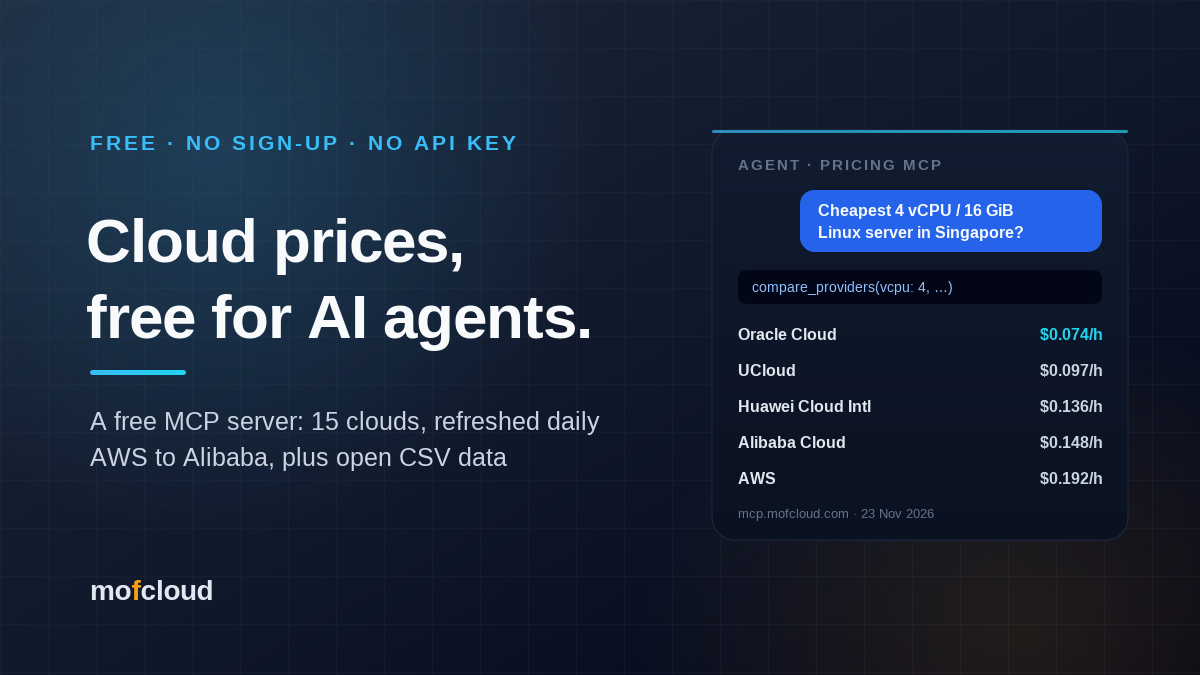
Which cloud is cheapest for a 4 vCPU / 16 GiB Linux server in Singapore?
The agent calls compare_providers with vcpu: 4, mem_gib: 16, country: "SG", which returns the cheapest matching type on each cloud. Dedicated-core types only (burstable types like AWS t3 are left out unless you ask), on-demand, Singapore regions:
| Cloud | Instance | Arch | USD / hour | ≈ USD / month |
|---|---|---|---|---|
| Oracle Cloud | VM.Standard.E4.Flex (2 OCPU) | x86 | $0.074 | $54 |
| UCloud | o.c4m16.ampere | Arm | $0.0971 | $71 |
| Huawei Cloud Intl | kc1.xlarge.4 | Arm | $0.136 | $99 |
| Alibaba Cloud (China site) | ecs.g8y.xlarge | Arm | $0.1484 | $108 |
| Volcengine | ecs.g4i.xlarge | x86 | $0.153 | $112 |
| Alibaba Cloud Intl | ecs.g8y.xlarge | Arm | $0.1538 | $112 |
| Vultr | voc-g-4c-16gb-80s-amd | x86 | $0.164 | $120 |
| Google Cloud | e2-standard-4 | x86 | $0.1653 | $121 |
| Azure | Standard_D4ps_v6 | Arm | $0.175 | $128 |
| AWS | m6g.xlarge | Arm | $0.192 | $140 |
| Akamai Linode | g8-dedicated-16-4 | x86 | $0.21 | $153 |
Source: MofCloud Pricing MCP, November 23, 2026. Monthly = hourly × 730.
Two things stand out. The spread is almost 3× between the cheapest and the most expensive for the same shape in the same city. And the China and International sites of the same cloud don’t charge the same: Alibaba’s g8y is $0.1484 on the China site and $0.1538 on the International site, both for Singapore.
What does 1 TB of internet egress cost?
Egress is tiered on most clouds, so a single $/GB rate understates or overstates the bill. compare_egress prices the whole volume through the tiers. 1 TB (1,024 GB) a month out of a US East region:
| Cloud | Region | USD for 1 TB / month |
|---|---|---|
| Akamai Linode | us-east, us-iad (and every US region) | $5.12 |
| Vultr | ewr, atl and other US regions | $10.24 |
| Tencent Cloud | na-ashburn (Virginia) | $76.49 |
| Alibaba Cloud Intl | us-east-1 (Virginia) | $77.82 |
| Azure | eastus | $80.39 |
| AWS | us-east-1 | $92.16 |
Source: MofCloud Pricing MCP, list prices, November 23, 2026. Free allowances aren’t subtracted: AWS and Azure each give the first 100 GB a month free, and Linode and Vultr bundle a transfer pool with each instance, so their rows are the overage rate.
Here’s our take: for a bandwidth-heavy workload, egress can decide the cloud more than the server price does. A $54/month server that pushes 5 TB a month on a hyperscaler pays several times its own price in egress. That’s why the MCP exposes egress, fixed bandwidth (common on Chinese clouds) and public IPs as separate tools, so an agent can add them up.
What does a managed MySQL database cost in Singapore?
search_databases covers managed MySQL and PostgreSQL on AWS, Azure, Google Cloud, Alibaba Cloud, Tencent Cloud and Huawei Cloud. 2 vCPU / 8 GiB, single-zone, on-demand, Singapore, instance price only (storage extra):
| Cloud | Instance class | USD / hour | ≈ USD / month |
|---|---|---|---|
| Alibaba Cloud (China site) | mysql.n4.medium.1 | $0.0947 | $69 |
| Google Cloud SQL | db-custom-2-8192 | $0.194 | $142 |
| Huawei Cloud Intl | rds.mysql.n1-v2.large.4 | $0.198 | $145 |
| AWS RDS | db.t4g.large (burstable) | $0.203 | $148 |
| AWS RDS | db.m6g.large | $0.209 | $153 |
| Azure Database for MySQL | Dasv6, 2 vCores | $0.232 | $169 |
Source: MofCloud Pricing MCP, November 23, 2026. Monthly = hourly × 730. Set storage_gib and the tool adds storage to the monthly total.
In one line: the same question gets a ranked, sourced table, and every row links back to its instance page on mofcloud.com/tools so you can check it.
How do I connect it to Claude, Cursor, VS Code or ChatGPT?
Any client that speaks remote MCP over streamable HTTP works. The endpoint is https://mcp.mofcloud.com/, with no authentication.
Claude (claude.ai or Claude Desktop). Open Customize → Connectors, click +, then Add custom connector. Name it MofCloud Pricing, paste https://mcp.mofcloud.com/, choose No sign in under Authentication, then Add. Free plans allow one custom connector.
Claude Code. Run this in a terminal; add --scope user to use it in every project:
claude mcp add --transport http mofcloud-pricing https://mcp.mofcloud.com/Cursor. Add this to .cursor/mcp.json in your project, or ~/.cursor/mcp.json for every project:
{ "mcpServers": { "mofcloud-pricing": { "url": "https://mcp.mofcloud.com/" } }}VS Code (GitHub Copilot). Add this to .vscode/mcp.json, or run MCP: Add Server from the Command Palette, choose HTTP and paste the URL:
{ "servers": { "mofcloud-pricing": { "type": "http", "url": "https://mcp.mofcloud.com/" } }}ChatGPT. On the web, go to chatgpt.com/plugins, click +, then Add custom MCP server (developer mode). Paste the URL as the Server URL, choose No authentication, create it as a plugin, install it, then type @ in a chat to use it.
Then ask a price question in plain words. A good first one: “Using MofCloud Pricing, which cloud is cheapest for 8 vCPU / 32 GiB in Frankfurt?”
What are the 15 tools?
| Group | Tools |
|---|---|
| Servers and GPUs | search_instances, compare_providers, gpu_options, get_instance, price_changes |
| Network | compare_egress, compare_bandwidth, compare_eip |
| Storage | search_disks, compare_disk_providers, compare_snapshots |
| Databases | list_db_categories, search_databases |
| Lookup | list_facets, list_regions |
list_regions turns “near Singapore” or “Europe” into region codes on every cloud, and price_changes reports new and delisted types, price rises and cuts. The full descriptions are on the Pricing MCP page.
Where does the data come from, and how fresh is it?
From each cloud’s own public price lists: the AWS offer files, the Azure Retail Prices API, the Google Cloud billing catalog, and the price APIs and calculators of Alibaba, Tencent, Huawei, Volcengine, Baidu, UCloud, Oracle, Linode and Vultr. Alibaba, Tencent and Huawei have separate China and International catalogs, which we keep apart: 15 catalogs from 12 clouds.
- Sync: a Go service pulls every catalog daily starting 01:00 Beijing time and normalizes it into one schema (instance specs, on-demand, monthly/yearly subscription, reserved and spot where the cloud sells them).
- Publish: a read-only copy of the tables reaches the public server at about 05:00 Beijing time (21:00 UTC) every day.
- Currency: prices are stored in the cloud’s own currency and converted to USD at query time.
- List prices only: your negotiated discounts, credits and free tiers aren’t included.
The public server runs on its own small box behind Cloudflare, with a read-only database user. The limits: 30 tool calls per minute per IP, 20,000 calls a day for the whole server, at most 50 rows per call (with the total match count, so the agent can narrow the question). That’s plenty for an agent answering a person; if you want to crunch the whole catalog, download the data instead.
Can I download the data instead?
Yes. The same prices are published every day as plain CSV in the mofcloud/cloud-pricing repository on GitHub, free under CC BY 4.0: use them in a spreadsheet, a notebook or your own tool, and credit MofCloud.
| File | What’s in it |
|---|---|
instances.csv |
11k+ instance types: specs, cheapest on-demand, spot and reserved |
gpu-instances.csv |
GPU and AI accelerators: H100, H200, B200, A100, L40S, MI300X… |
disks.csv |
Block storage per GiB·month, per disk type and region |
egress.csv |
Internet egress per region, priced for 1 TiB |
bandwidth.csv |
Fixed bandwidth per Mbps, common on Chinese clouds |
public-ip.csv |
Public IPv4 per month, attached or idle |
Every daily update is a git commit, so the price history is in the repo too.
How is this different from the MCP in Mofis and MOF?
They answer different questions.
- MofCloud Pricing MCP (this one) looks up public list prices. It’s free, open to everyone, and knows nothing about you.
- Mofis and MOF come with their own MCP that connects to your own cloud bills: what you actually spent, on which accounts and services, and where you can save. That needs your billing data, so it runs inside those products, not on a public server.
A typical flow uses both: the Pricing MCP tells you what a move would cost at list price, and your bill tells you what you’re paying today.
FAQ
Is the MofCloud Pricing MCP really free? Yes. No sign-up, no API key, no paid tier. Each IP can make 30 tool calls a minute.
Which clouds does it cover? AWS, Azure, Google Cloud, Oracle Cloud, Alibaba Cloud, Tencent Cloud, Huawei Cloud, Volcengine, Baidu AI Cloud, UCloud, Akamai Linode and Vultr: 15 price catalogs counting the separate China and International sites.
How often are prices updated? Daily. New prices reach the public server at about 05:00 Beijing time (21:00 UTC).
Does it include spot, reserved and subscription prices? Yes, where the cloud publishes them: on-demand, monthly and yearly subscription, reserved (1 and 3 years, by payment option) and spot.
Does it include burstable instances like AWS t3 or Azure B-series?
Not by default, because their price buys a CPU baseline rather than a full core. Ask for them and the agent sets include_burstable.
Can I use the data in my own product? Yes, under CC BY 4.0 with credit to MofCloud. Download the CSVs from GitHub.
Does it know my discounts or my bill? No. It’s public list prices only. For your own bills, see Mofis.
If something’s wrong or missing, tell us: open an issue on GitHub. Set it up from the Pricing MCP page, or browse the same data in our free pricing tools.