Multi-cloud billing in 2026: one view of AWS, Azure, Google Cloud and Alibaba, Tencent, Huawei bills
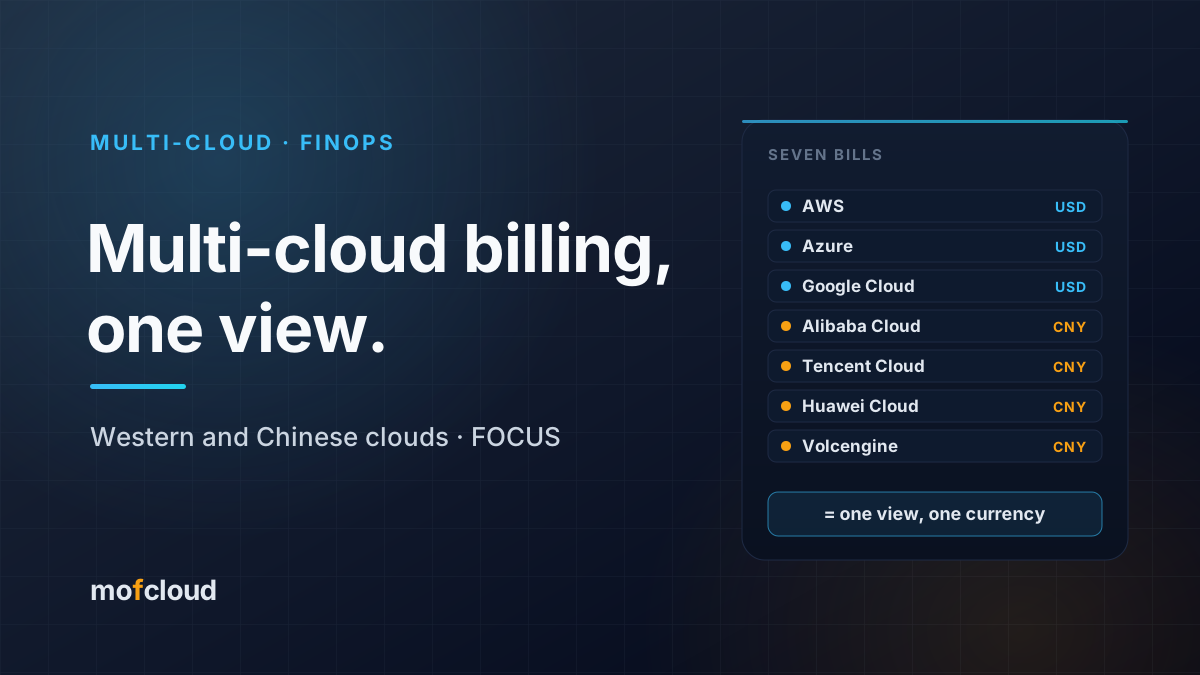
How to put AWS, Azure, Google Cloud, Alibaba Cloud, Tencent Cloud, Huawei Cloud and Volcengine bills in one view: how each cloud exports its bill, where FOCUS helps and where it doesn't, and the five things that never line up on their own.
 MofCloud
Nov 18, 2026 · 11 min read
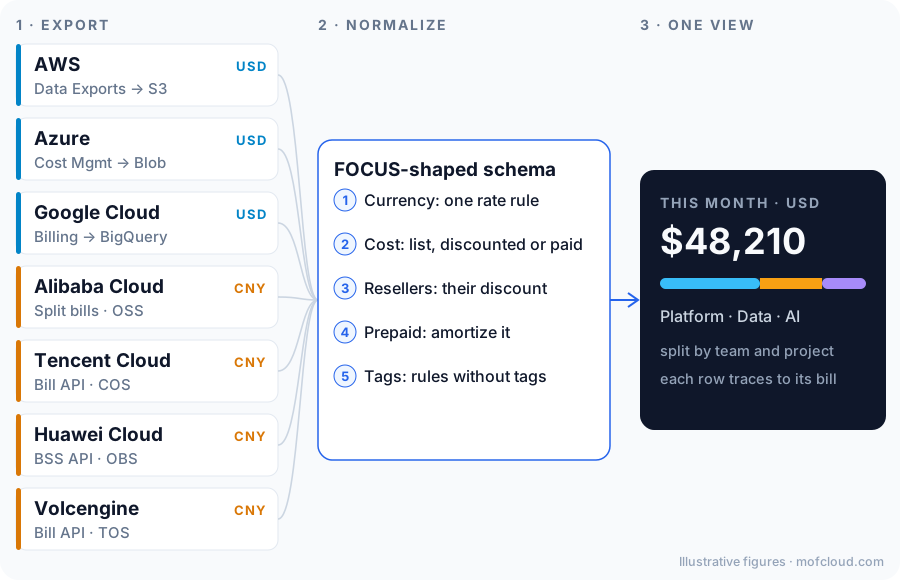
Multi-cloud billing means getting every cloud’s bill into one set of numbers you can add up, compare and split by team. The dashboard is the easy part. The hard part is that AWS, Azure, Google Cloud, Alibaba Cloud, Tencent Cloud, Huawei Cloud and Volcengine each export their bill in a different shape, a different currency and with different ideas of what “cost” means. Until those are normalized, a combined total is just two numbers that happen to sit next to each other.
This guide covers how each of the seven clouds exports its bill as of November 2026, how far the FOCUS standard gets you (including on the Chinese clouds, which most guides skip), the five mismatches you’ll still have to fix yourself, and three ways to end up with one view.
What is multi-cloud billing?
Multi-cloud billing is the practice of collecting cost and usage data from every cloud provider you pay, converting it into one schema and one currency, and attributing it to the teams, products and projects that caused it.
It’s the foundation for everything else in FinOps: budgets, showback, anomaly alerts and savings work all assume you can trust the combined number. If you run on more than one cloud, and especially if one of them is a Chinese cloud, this is where most of the effort goes.
In one line: multi-cloud billing is a data-normalization problem first and a reporting problem second.
How does each cloud export its bill?
Every provider offers two routes: a billing API you can query, and a scheduled file export to its own object storage. For anything beyond a monthly total, you want line items, which means the file export or the detailed API.
| Cloud | Line-item source | Where files land | Granularity and timing | FOCUS export (Nov 2026) |
|---|---|---|---|---|
| AWS | Data Exports (CUR 2.0), Cost Explorer API | S3 | Hourly, daily or monthly; refreshed up to once a day | FOCUS 1.2, generally available since November 2025; not in the China or GovCloud regions |
| Azure | Cost Management exports, Query API | Blob Storage | Daily (month to date) or monthly; data lands in 8–24 hours on EA and MCA, up to 72 on pay-as-you-go | FOCUS 1.0 generally available; FOCUS 1.2 in preview |
| Google Cloud | Cloud Billing export | BigQuery | Hourly usage windows; usually within a day, with no latency guarantee | Native FOCUS export in preview since June 2026, up to FOCUS 1.2 |
| Alibaba Cloud | Split-item bills API (DescribeSplitItemBill) |
OSS (bill subscription) | Daily files with the previous day; the full month on the 3rd | FOCUS 1.0 in invitation-only preview, “for analysis, not for reconciliation” |
| Tencent Cloud | Billing API (DescribeBillDetail) |
COS (bill storage) | Daily, delivered the next day; the month on the 2nd | FOCUS 1.0 daily and monthly files, China and international sites; not yet recommended for production |
| Huawei Cloud | BSS API (ListCustomerselfResourceRecords) |
OBS (Cost Center dump) | Daily or monthly; the month closes on the 4th | FOCUS 1.0, daily only, labelled beta on some sites |
| Volcengine | Billing API (ListBillDetail) |
TOS (bill storage) | Daily increments, “for reference only”; the month on the 2nd | None found |
The API names in that table are the ones we call in production for Mof, our self-hosted cost platform, which has been pulling these bills since 2022. A few things the docs don’t tell you up front:
- The Chinese clouds’ APIs are the reliable route today. Their FOCUS exports are new, partial, or in preview. If you need numbers you can reconcile against an invoice, read the native bill.
- Daily isn’t real time. Most of these bills arrive the next day and keep changing until the month closes, as credits, discounts and adjustments land. Treat the current month as provisional.
- China regions are separate accounts with separate bills. AWS China (Beijing and Ningxia) and Azure China are billed apart from the global accounts, in CNY, and AWS’s FOCUS export doesn’t cover them.
Does FOCUS solve multi-cloud billing?
FOCUS (the FinOps Open Cost and Usage Specification) is the FinOps Foundation’s common schema for cloud bills. It gives every provider the same column names, including four cost columns that matter most: ListCost (public price), ContractedCost (after negotiated rates), BilledCost (what the invoice says) and EffectiveCost (with prepaid commitments amortized). The latest release is FOCUS 1.4 (June 2026), but what providers ship today is mostly 1.2, and the Chinese clouds that support it are on 1.0.
It’s a real step forward. If all your providers emit FOCUS, you can load their files into one table without writing a mapper per cloud.
But FOCUS standardizes columns, not money. As of November 2026, it doesn’t remove the work in the next section, for three reasons:
- Coverage is uneven. AWS’s FOCUS 1.2 export is generally available, while Azure’s and Google Cloud’s 1.2 exports are previews. Alibaba, Tencent and Huawei ship 1.0: Alibaba says not to use it for reconciliation, Tencent doesn’t yet recommend it for production (columns such as
EffectiveCostcome back empty), and Huawei’s is labelled beta on some of its sites. We found no FOCUS export for Volcengine. - Each provider fills the columns its own way. “Contracted” and “effective” depend on how that provider models discounts and prepaid plans, which differs a lot between a Western enterprise agreement and a Chinese cloud’s prepaid instance.
- It doesn’t pick your currency or your view of credits. You still decide how to treat CNY versus USD, vouchers, and resellers.
Our take: adopt FOCUS as the target schema, and keep the native bill as the source of truth for the Chinese clouds until their exports mature.
What doesn’t line up between Western and Chinese cloud bills?
These are the five mismatches we see most often when AWS, Azure or Google Cloud meet Alibaba, Tencent, Huawei or Volcengine in one report.
1. Currency
Chinese clouds bill domestic accounts in CNY; their international sites bill in USD. AWS and Azure China regions bill in CNY too. You need one reporting currency and a stated exchange rate for each period: a daily rate, a monthly average, or the rate on the invoice date. Pick one, write it down, and apply it everywhere, or month-over-month comparisons will move with the exchange rate rather than with usage.
2. List price versus what you actually pay
Chinese clouds apply discounts at several levels: account-level discounts, product promotions, and vouchers and coupons (代金券 / 优惠券) that are deducted at payment time. The bill often shows the pre-voucher amount in one field and the amount paid in cash in another. AWS has the same idea with credits and the Savings Plans negative line items, but the field names and signs differ. Decide whether your reports show list, after-discount, or cash paid, and map each cloud to that choice.
3. Accounts bought through a reseller
A lot of AWS, Azure and Google Cloud spend in Asia goes through resellers, and many companies outside China buy Alibaba or Tencent Cloud through a local partner. A reseller account may hide the payer’s billing data, or apply its own discount that never appears in the provider’s export. You either need access to the reseller’s statement or a “reseller mode” that applies their discount on top of the list price. We wrote about this for AWS, Azure and Google Cloud.
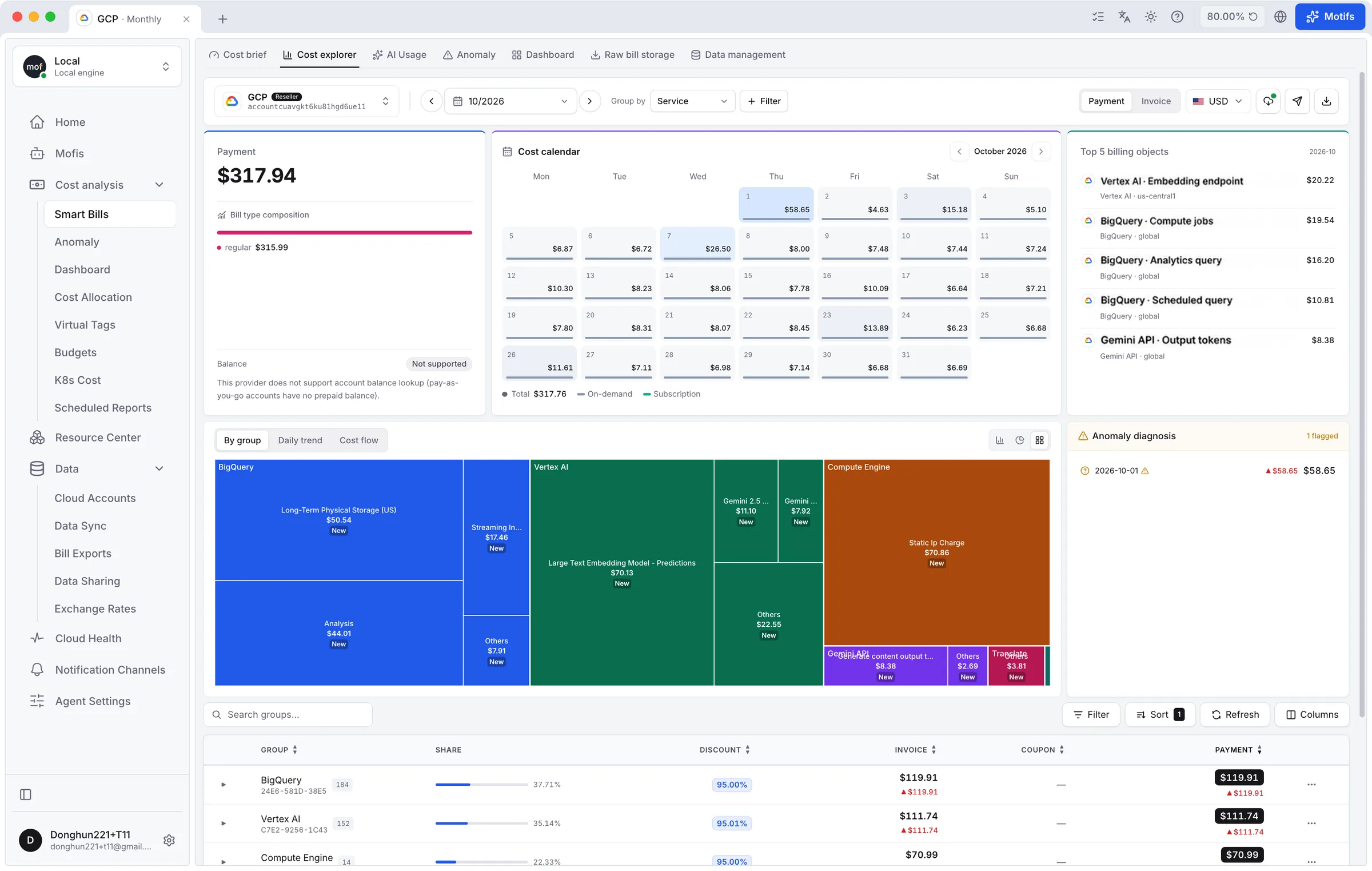
A Google Cloud account bought through a reseller, in Mofis: the discount, coupons and the amount actually paid sit side by side, and one switch flips the whole view between payment and invoice.
4. Prepaid (subscription) resources
Chinese clouds sell many resources as monthly or yearly subscriptions (包年包月) charged up front. A one-year ECS purchase lands as one large charge in the month you pay. If you don’t spread it over the period it covers, that month looks enormous and the next eleven look free. AWS Reserved Instances paid all upfront have the same problem; FOCUS’s EffectiveCost exists for exactly this, but you need the amortized figure from each provider (or to compute it yourself).
5. Tags and resource names
Allocation depends on tags, and every cloud handles them differently: how many tags a resource can carry, whether tags show up in the bill at all, and from when. On the Chinese clouds, a tag usually reaches the bill only after you switch it on for billing:
- Alibaba Cloud: turn on tag-based cost allocation and pick which tags count as cost tags (费用标签); a newly bound tag shows up in split bills after a day. Up to 20 tags per resource.
- Tencent Cloud: only tag keys you set as cost allocation tags (分账标签) appear in bills, up to 100 keys. They take effect the next day and apply from that month on, not to earlier months. Up to 50 tags per resource.
- Huawei Cloud: activate tags as cost tags (成本标签) in Cost Center. They don’t apply to costs from before activation, and show up about a day after the resource incurs cost. Typically 20 tags per resource.
So last quarter’s bills are often untagged even after you fix tagging today. In practice you’ll need rules that work without tags, for example by account, project or resource name. That’s what virtual tags are for.
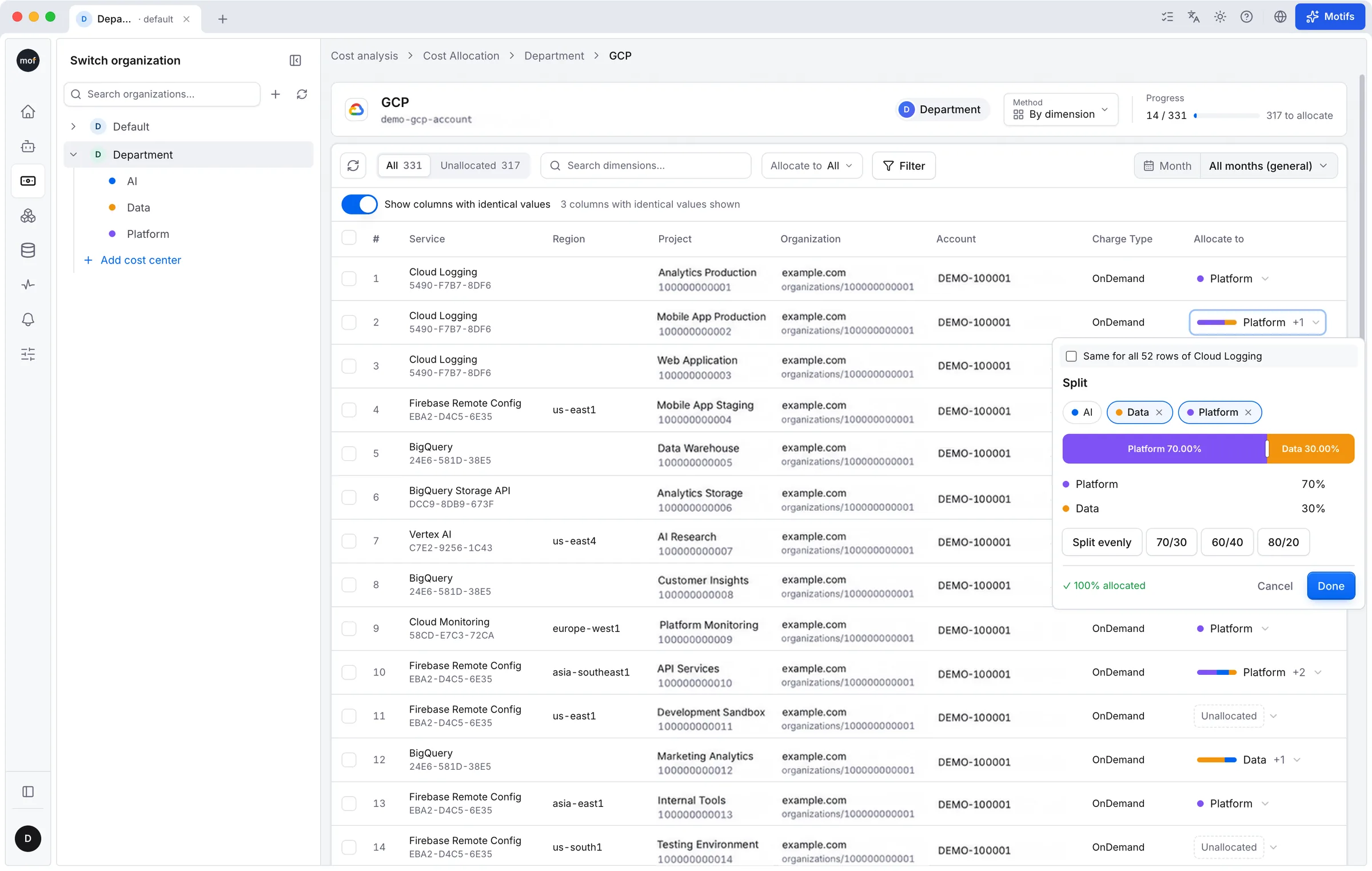
Allocating untagged rows in Mofis: each line goes to a team, and shared lines are split by percentage.
Three ways to get one view
There’s no single right answer; it depends on how many clouds you run, who needs the numbers, and how much engineering time you’ll spend.
| Build it yourself | General FinOps platform | Mofis | |
|---|---|---|---|
| What it is | Exports or APIs into your own warehouse (BigQuery, ClickHouse, Athena), a FOCUS-shaped model, a BI tool on top | SaaS such as Vantage, Finout, CloudZero or Cloudability | A desktop app that reads every cloud’s bill with read-only keys and keeps the data on your machine |
| Chinese clouds | Whatever you build | Varies; check each vendor’s current list for Tencent, Huawei and Volcengine | Alibaba, Tencent, Huawei, Volcengine, Baidu, UCloud and Kingsoft, alongside AWS, Azure, Google Cloud and others |
| Effort | Weeks to months, plus upkeep when exports change | Days | Minutes per account |
| Where data lives | Your infrastructure | The vendor’s cloud | Your computer, or your own PostgreSQL for a team |
| Cost | Engineering time and warehouse spend | Usually a percentage of cloud spend or a platform fee | Free for one person (up to 5 accounts); Pro at $49 per user a month |
| Best for | Teams with a data platform and specific modeling needs | Western-cloud estates with a FinOps team | Teams running Chinese and Western clouds together who want the numbers this week |
| Build it yourself if you already run a warehouse and need custom models. Start with FOCUS as the target schema, read the native APIs for the Chinese clouds, and budget for maintenance: bill formats change several times a year. |
Use a general FinOps platform if your spend is mostly on AWS, Azure and Google Cloud and you have people whose job is cost. Check Chinese cloud support carefully; coverage of Tencent, Huawei and Volcengine is the thinnest part of most vendors’ lists. We compared them in FinOps tools for Chinese clouds.
Use Mofis if you run a mix of Western and Chinese clouds and want one view without a project. It reads each cloud’s native bill, handles CNY and USD with stated exchange rates, applies reseller discounts, splits cost by team with virtual tags, and has an AI cost architect that explains what changed and what to cut. Where it isn’t the right fit: if you need a SaaS that the whole company logs into without installing anything, or deep Kubernetes-only allocation, a general platform may suit you better.
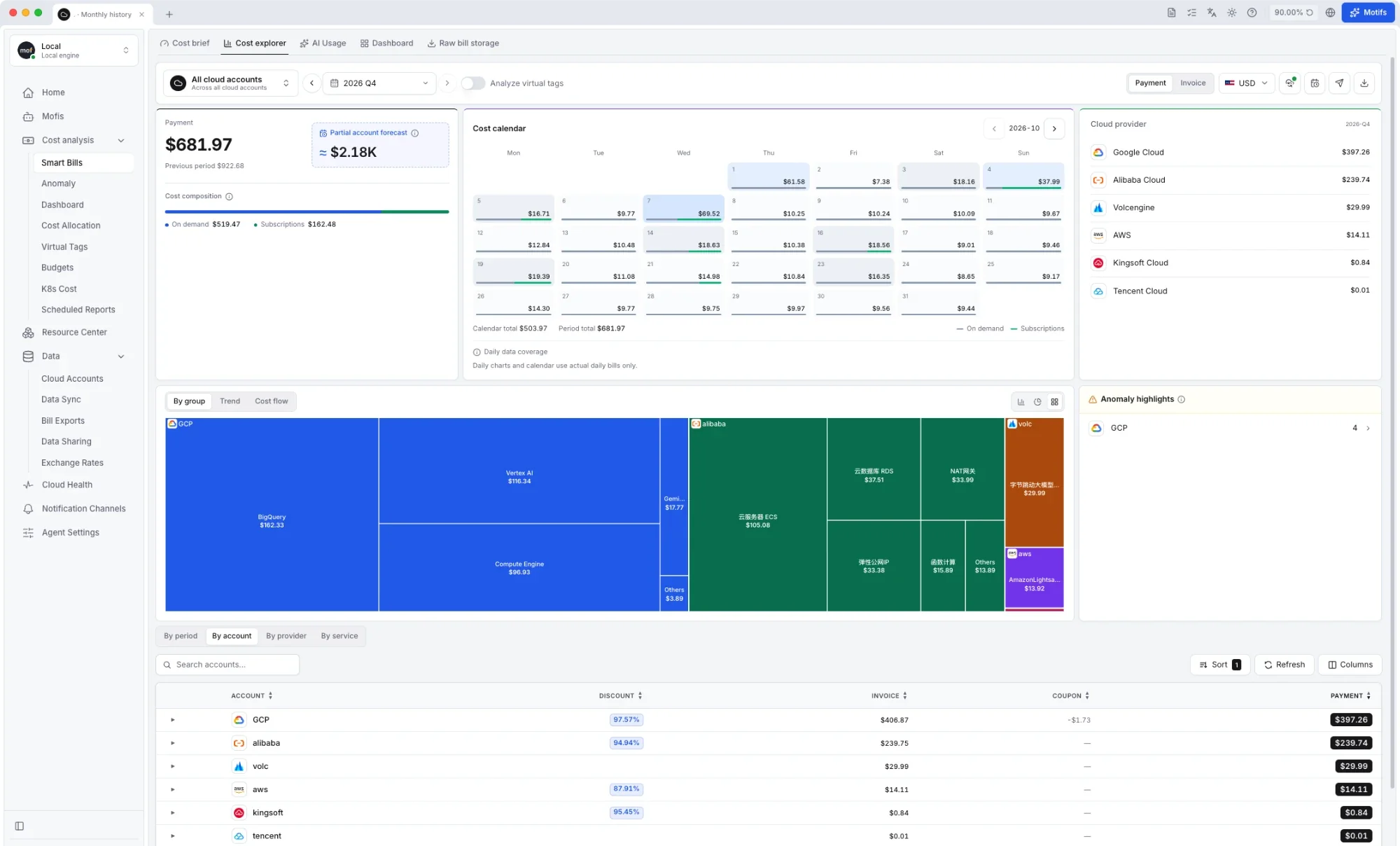
One quarter across six clouds in Mofis, in one currency: Google Cloud’s BigQuery next to Alibaba’s ECS and NAT gateway and Volcengine’s Doubao models, with each account’s discount, coupons and amount paid.
A checklist for one trustworthy number
- List every account you pay, including China-region accounts and anything bought through a reseller.
- Turn on line-item exports or API access for each, with read-only credentials. Our provider setup guides walk through each cloud.
- Pick a reporting currency and an exchange-rate rule, and write both down.
- Choose your cost view: list, after discounts, or cash paid. Map each cloud to it, including vouchers and credits.
- Amortize prepaid resources over the period they cover.
- Define allocation rules that work with and without tags.
- Reconcile one month against invoices before anyone relies on the numbers.
FAQ
Can one tool show AWS and Alibaba Cloud bills together?
Yes. Several tools read both; the question is how they normalize currency, discounts and prepaid resources. Check how a tool treats CNY and vouchers before trusting a combined total.
Do Chinese clouds support FOCUS?
Partly. As of November 2026, Alibaba Cloud, Tencent Cloud and Huawei Cloud all offer a FOCUS 1.0 export, but each comes with a caveat: Alibaba’s is an invitation-only preview not meant for reconciliation, Tencent doesn’t yet recommend it for production, and Huawei’s is daily-only and labelled beta on some sites. We found no FOCUS export for Volcengine. The native billing APIs remain the dependable source.
How often do cloud bills update?
Most providers deliver daily line items the next day, and keep revising the current month until it closes. Final numbers usually settle a few days into the next month.
How do I handle CNY and USD in one report?
Pick one reporting currency, convert with a stated rule (daily rate or monthly average), and store the original amount and currency next to the converted one so you can audit it later.
What about cloud accounts bought through a reseller?
Ask the reseller for detailed statements or billing access. If you can only see list prices, apply the reseller’s discount yourself so the totals match what you’re invoiced.
Is building it in-house worth it?
If you already have a data platform and two or three clouds, maybe. Most teams underestimate the upkeep: every provider changes its bill format, and the Chinese clouds change theirs often.
Running more than one cloud? Mofis puts every bill in one view on your own computer. It’s free for one person, with a 14-day Pro trial and no card required.