Alibaba Cloud cost management for international teams: accounts, billing and the line items that surprise you
A practical guide to Alibaba Cloud costs for teams outside China: China site vs international site, subscription vs pay-as-you-go vs savings plans, bandwidth and data transfer, Model Studio region pricing, the native cost tools, and how to put Alibaba next to AWS, Azure and Google Cloud.
 MofCloud
Nov 19, 2026 · 8 min read
Managing Alibaba Cloud costs from outside China comes down to four things: knowing which of Alibaba’s two sites your account is on, choosing the right billing method for each resource, watching bandwidth and model-inference charges, and spreading prepaid subscriptions over the months they cover. Get those right and Alibaba Cloud behaves much like AWS on a cost report. Get them wrong and one month looks enormous, the next eleven look free, and nobody can explain the gap to finance.
This guide is for teams that already know AWS, Azure or Google Cloud and now have Alibaba Cloud on the bill, usually because they’re expanding into China or Southeast Asia. Facts are as of November 2026, with links to Alibaba’s documentation.
China site or international site: which account do you have?
Alibaba Cloud runs two separate sites, aliyun.com (China) and alibabacloud.com (international). They are not two views of one account. Alibaba’s own comparison says the account data of the two sites is completely isolated, and an account can’t be moved from one to the other (source).
| China site (aliyun.com) | International site (alibabacloud.com) | |
|---|---|---|
| Currency | CNY | USD, with other currencies for settlement |
| Tax | Prices include VAT | Prices exclude tax; tax added by your country or region |
| Payment | Alipay, WeChat Pay, UnionPay, corporate bank transfer | Credit card, PayPal, bank transfer and others |
| Registration | Mainland China mobile number; real-name verification before buying anything | Email and a non-mainland mobile number; real-name verification only for mainland resources or credit lines |
| Regions you can buy | All regions except Saudi Arabia | All regions |
| Account data stored | Mainland China | Outside mainland China |
| New features | Usually ship here first | Focus on core global products |
Three cost consequences follow:
- You’ll often have both. A team in Singapore on the international site that opens a China subsidiary usually ends up with a China-site account too, with a second bill, a second currency and a second set of discounts.
- Prices aren’t directly comparable. A China-site price includes VAT; an international price doesn’t. Compare pre-tax to pre-tax, or tax-inclusive to tax-inclusive, never one against the other.
- Running a website in mainland China needs an ICP filing, whichever site you buy from. It’s not a cost line, but it decides which regions you can actually serve traffic from.
How does Alibaba Cloud bill compute?
Like AWS, Alibaba gives you a few base billing methods and a few discounts on top. For ECS (Alibaba’s equivalent of EC2), per Alibaba’s billing overview:
| Method | What it is | AWS equivalent | Good for |
|---|---|---|---|
| Subscription (包年包月) | Prepaid for a month or more, for one specific instance | All-upfront reserved capacity for one instance | Steady workloads you’re sure about |
| Pay-as-you-go | Billed by usage, no commitment | On-demand | Anything variable or short-lived |
| Spot (preemptible) | Discounted spare capacity that can be reclaimed | Spot | Batch, CI and fault-tolerant jobs |
| Savings plan | A spend commitment that discounts pay-as-you-go usage, across regions | Savings Plans | Steady baseline that may change shape |
| Reserved instance | A discount that applies to matching pay-as-you-go instances, up to 100 of them | Reserved Instances | Narrow cases where you need zonal capacity |
Alibaba itself recommends savings plans over reserved instances, since they’re more flexible and discount more. Two details trip people up: savings plans and reserved instances discount pay-as-you-go usage only, not spot; and a savings plan doesn’t reserve capacity, while a zonal reserved instance does.
Our take: teams coming from AWS tend to buy subscriptions because the console pushes them and the discount looks large. Subscriptions lock the discount to one instance in one region. If your architecture is still moving, a savings plan over pay-as-you-go usually costs a little more on paper and much less in practice, because you’re not paying for instances you’d rather have resized.
Which Alibaba Cloud line items surprise teams from AWS?
Prepaid subscriptions that spike one month
A one-year subscription is charged in full in the month you buy it. On a cash basis, that month looks huge and the following eleven look free. Any monthly cost report has to amortize subscriptions over the period they cover, or month-over-month comparisons are meaningless. Watch auto-renewal too: subscriptions you’ve forgotten about renew at the same size.
Public bandwidth: by bandwidth or by traffic
ECS public bandwidth can be billed by a fixed bandwidth you reserve or by the traffic you actually send (public bandwidth billing). Fixed bandwidth suits steady, high utilization; by-traffic suits spiky or low use. Picking fixed bandwidth “to be safe” on a lightly used instance is one of the most common silent overspends we see.
Data transfer and the CDT free quota
Many Alibaba products now bill internet data transfer through CDT (Cloud Data Transfer), with tiered prices per region: the more you transfer, the lower the unit price. Since June 1, 2025, CDT includes a free quota of 220 GB a month on BGP (Multi-ISP) lines, 20 GB for mainland China regions and 200 GB for regions outside the mainland (source). BGP Pro lines have no free quota. If you serve mainland users, that 20 GB goes fast.
Model Studio: the same Qwen model at different prices by region
If you call Qwen through Alibaba Cloud Model Studio (Bailian), the price depends on which deployment serves the request. As of November 18, 2026, qwen3.5-flash is $0.10 input and $0.40 output per million tokens in the International (Singapore) deployment, and $0.029 and $0.287 in China (Beijing) for requests up to 128K tokens (Model Studio pricing). Singapore keeps inference outside mainland China and comes with a free quota; Beijing is cheaper. Several Qwen models also price a whole request by its total input length, so a long prompt moves every token in it to a higher tier. Model inference is billed per minute and can be split by API key, workspace and model (source), which is useful if you give each application its own key. We compare Qwen with OpenAI, Anthropic, DeepSeek and Doubao in LLM API cost tracking, and break down Model Studio bills in this post.
Vouchers and discounts that change what “cost” means
Alibaba applies account discounts, promotions and vouchers at payment time, and the bill shows the pre-voucher amount and the cash paid in different fields. Decide which one your reports use and stick to it.
What cost tools does Alibaba Cloud give you?
Alibaba’s Expenses and Costs console covers the basics well for a single account:
- Bill details and cost analysis by product, account, region, instance and tag, with exports covering the last 18 months (source).
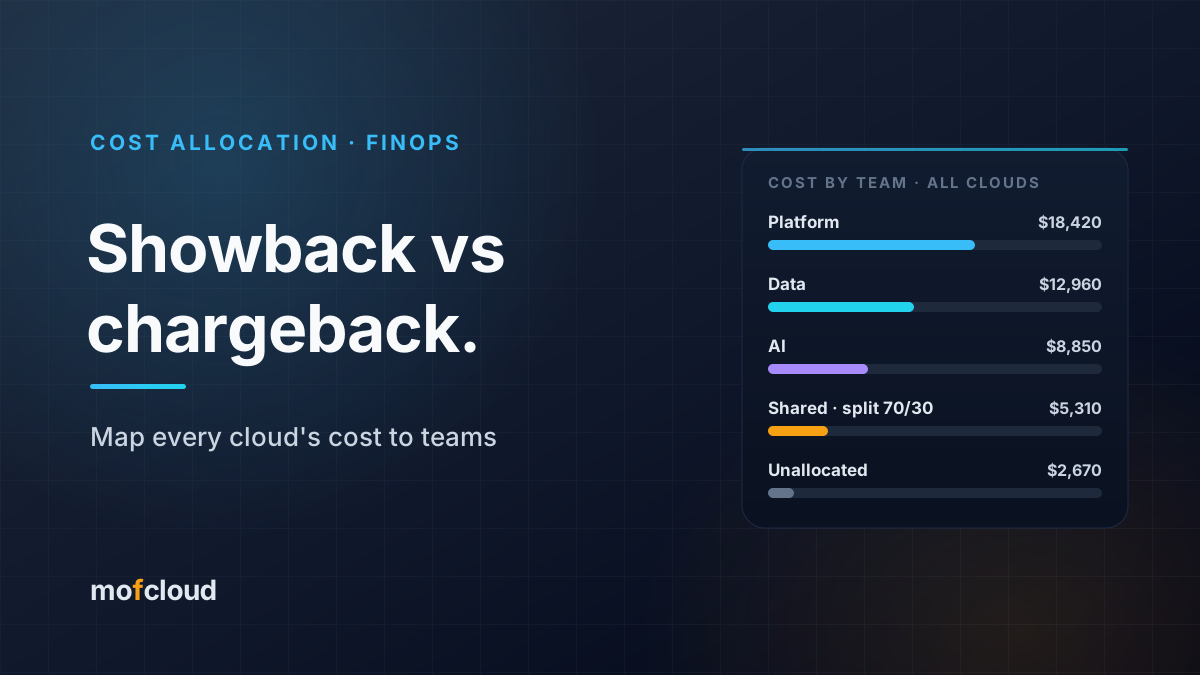
- Cost allocation by cost center or tag. Turn on tag-based allocation and choose which tag keys count; a newly bound tag shows up the next day, and split bills are for internal use, not invoicing.
- Budgets with alerts and estimate-versus-actual tracking (source).
- Bill subscription to OSS, which drops daily line-item files into a bucket, and the
DescribeSplitItemBillAPI for the same data. - A FOCUS 1.0 export in invitation-only preview, which Alibaba says is for analysis, not reconciliation.
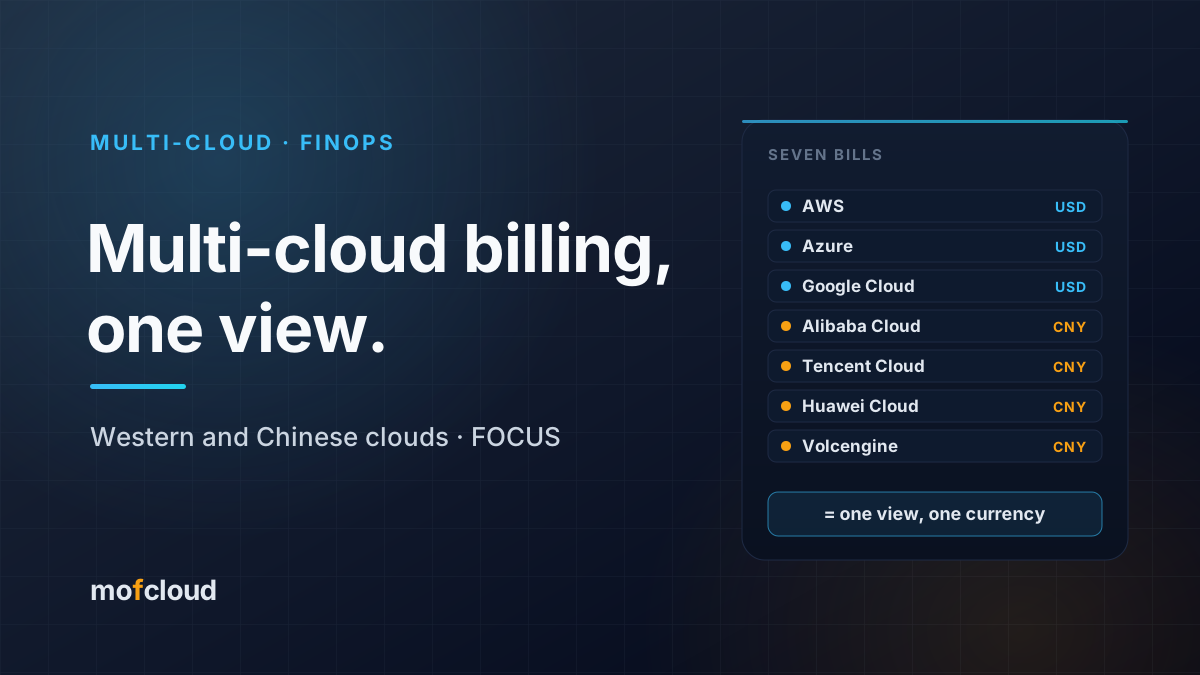
Where it stops: it sees one site and one account family at a time. It won’t put your China-site and international-site accounts side by side in one currency, and it won’t show Alibaba next to AWS, Azure or Google Cloud. For that you need either your own pipeline or a multi-cloud tool, which we compare in multi-cloud billing.
How to put Alibaba Cloud next to AWS, Azure and Google Cloud
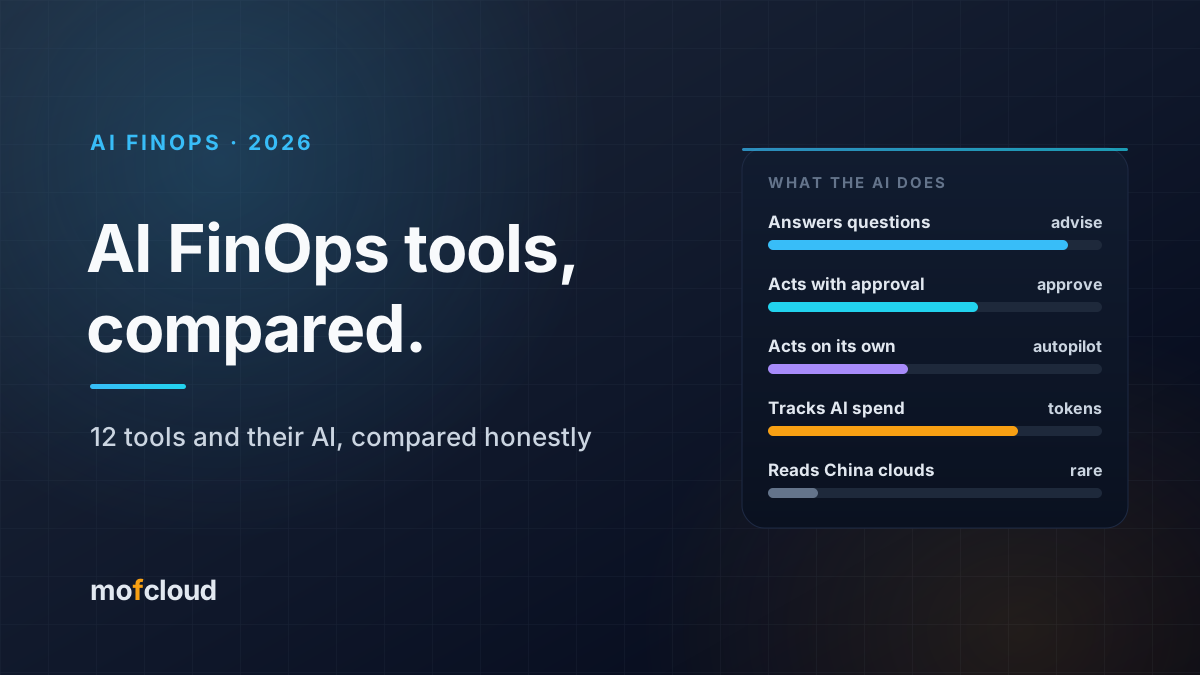
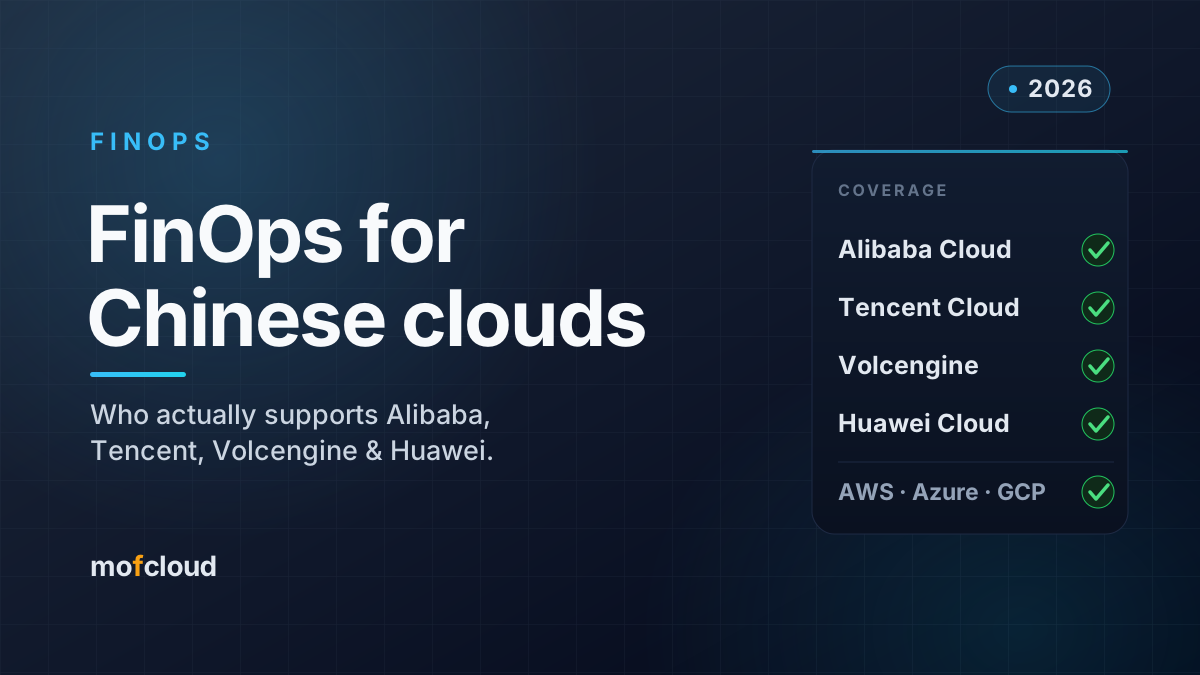
Few Western FinOps platforms read Alibaba Cloud natively. As of November 2026, DoiT and Finout list it among their integrations, and DoiT’s connector imports Alibaba’s FOCUS export; most others don’t list it, and Tencent, Huawei and Volcengine are rarer still. We keep the full picture in AI FinOps tools in 2026 and FinOps tools for Chinese clouds.
Mofis, our desktop app, reads Alibaba Cloud’s native bill with a read-only key (AliyunBSSReadOnlyAccess is enough), on both the China and international sites, alongside AWS, Azure, Google Cloud and the other Chinese clouds. It groups cost by service, region, charge type, tag and cost unit, shows discounts, vouchers and cash paid side by side, converts CNY and USD at a stated rate, breaks Model Studio spend down by model and key, and has an AI cloud architect you can ask why a month moved. Our Alibaba Cloud setup guide shows the exact permissions. If you’re weighing it against a Western platform, see our comparisons with Vantage, Finout and CloudZero.
A checklist for Alibaba Cloud costs
- List every Alibaba account on both sites, including accounts bought through a local partner.
- Create a read-only RAM user for billing on each, with
AliyunBSSReadOnlyAccessor a narrower custom policy. - Turn on cost tags now; they don’t apply to earlier bills.
- Amortize subscriptions and review auto-renewals each quarter.
- Check public bandwidth billing on every internet-facing instance.
- Give each AI application its own Model Studio API key, and record which deployment region it uses.
- Pick one currency, one exchange-rate rule and one tax treatment for reporting across sites and clouds.
FAQ
What’s the difference between aliyun.com and alibabacloud.com?
They’re Alibaba Cloud’s China site and international site. Accounts, billing and contracts are separate: the China site bills in CNY with VAT included, the international site in USD with tax added by country. You can’t move an account between them.
Can an international Alibaba Cloud account use mainland China regions?
Yes. Both sites can buy resources in mainland regions, but the international site requires real-name verification for mainland resources, and public websites hosted in mainland China need an ICP filing.
Should I use subscriptions or savings plans on Alibaba Cloud?
Alibaba recommends savings plans over reserved instances, and for most changing workloads they’re safer than subscriptions, which lock a discount to one instance. Use subscriptions for resources you’re confident won’t change for the whole term.
Does Alibaba Cloud support FOCUS?
Alibaba has a FOCUS 1.0 export in invitation-only preview and says it’s for analysis, not reconciliation. For numbers that must match invoices, use the native bill API or OSS bill files.
Which FinOps tools support Alibaba Cloud?
As of November 2026, DoiT and Finout list Alibaba Cloud among their integrations, and MofCloud reads it natively alongside Tencent, Huawei, Volcengine, Baidu, UCloud and Kingsoft. Alibaba’s own Expenses and Costs console covers single-site analysis for free.
Running Alibaba Cloud next to AWS or Google Cloud? Mofis puts every bill in one view, free for one person, with a 14-day Pro trial and no card required.