LLM API cost tracking: OpenAI, Anthropic, DeepSeek, Qwen and Doubao in one view (2026)
How to track LLM API costs across OpenAI, Anthropic, Google, DeepSeek, Alibaba Qwen and ByteDance Doubao: where each provider reports usage, the six pricing quirks that make token bills hard to compare, and three ways to get one number.
 MofCloud
Nov 19, 2026 · 10 min read
To track LLM API costs across providers, take each provider’s billed cost as the source of truth, attribute it with API keys or workspaces, and convert everything into one currency. That sounds simple until you put OpenAI next to DeepSeek and Alibaba’s Qwen: one bills in USD after the fact, one charges a prepaid balance at a price that changes with the time of day, and one bills the same model at different prices depending on which region served it.
This guide covers where each major provider reports usage and cost, six pricing quirks that make token bills hard to compare, a price table for the models teams actually mix, and three ways to get one number. Prices are as of November 19, 2026.
Where does each LLM provider report usage and cost?
Every provider has a usage page in its console. What differs is whether you can pull the data by API, how fine-grained it is, and what you can split it by.
| Provider | Where cost data lives | Granularity | Split by | Watch out for |
|---|---|---|---|---|
| OpenAI | Usage and Costs APIs (/v1/organization/costs), admin key |
Daily cost buckets | Project, line item, API key | Needs an organization admin key, not a project key |
| Anthropic | Usage and Cost Admin API, admin key | Usage by 1 minute, 1 hour or 1 day; cost daily, in USD | Model, workspace, API key, service tier, inference region | Priority Tier costs aren’t in the cost endpoint; individual Console accounts must create an organization first |
| Google (Gemini API, Vertex AI) | Cloud Billing export to BigQuery | Hourly usage windows | Project, SKU, labels | Lands with your other Google Cloud costs, typically within a day |
| DeepSeek | Usage page in the DeepSeek platform console, with record export | Per day and per key in the console | API key, model | Prepaid balance; we found no documented organization-level usage API |
| Alibaba Cloud Model Studio (Qwen) | Alibaba Cloud bill (Expenses and Costs) | Inference billed per minute, typically 2–10 minutes behind | API key, workspace, model, input/output, channel | Console calls and Batch Chat have an empty API key ID |
| Volcengine Ark (Doubao) | Volcengine bill, through the billing API (ListBillDetail) |
Daily, CNY on the China site | Product, instance | Daily increments are “for reference only” until the month closes |
| Tencent Cloud TokenHub (Hunyuan and others) | Cost allocation bill | T+1 | API key | Per-key cost allocation started May 16, 2026; earlier usage isn’t in it |
Two things stand out. First, the Chinese platforms put model spend on the cloud bill, next to compute and storage, while OpenAI and Anthropic run separate billing systems with their own APIs. Second, Alibaba Model Studio is unusually fine-grained: it bills inference per minute and encodes the API key, workspace and model in every line item, so you can attribute Qwen spend without a gateway.
In one line: Western model vendors give you a usage API; Chinese clouds give you a bill. You need both.
Six pricing quirks that make LLM bills hard to compare
A per-million-token price looks like it should be comparable across providers. In practice, six things move the number you actually pay.
1. The same model costs different amounts depending on where it runs
Alibaba Model Studio prices Qwen by deployment region. As of November 18, 2026, qwen3.5-flash costs $0.10 input / $0.40 output per million tokens in the International (Singapore) deployment and $0.029 / $0.287 in China (Beijing) for requests up to 128K tokens (Model Studio pricing). That’s about 3.4x on input for the same model. Western vendors do a milder version: Anthropic charges 1.1x for US-only inference on its newer models, and OpenAI adds a 10% uplift on its regional processing endpoints for models released from March 5, 2026.
2. The time of day changes the price
DeepSeek charges half price off-peak. Peak hours are 01:00–04:00 and 06:00–10:00 UTC on weekdays, excluding Chinese public holidays; everything else is off-peak (DeepSeek pricing). The same batch job costs twice as much at 08:00 UTC on a Tuesday as it does at 14:00. If you only track tokens, your cost per request will look like it’s drifting when nothing changed but the clock.
3. Long prompts can reprice the whole request
Several Qwen models use tiers set by the total input tokens of a single request, and every token in that request is billed at that tier’s rate. On qwen-flash in Beijing, crossing 128K input tokens takes input from $0.022 to $0.087 per million. Claude Haiku 5.5 does something similar above 100,000 tokens. One RAG pipeline that grows its context window can quietly move all its traffic into a pricier tier.
4. Cache hits are 10–50x cheaper, so hit rate drives cost
Cached input is priced at a fraction of fresh input: 10% on GPT-5.5 ($0.50 vs $5.00), 5% on Claude Opus 5.5 and Sonnet 5.5, and 2% on DeepSeek Flash ($0.006 vs $0.30 at peak). Two teams sending the same tokens to the same model can see bills that differ by several times because of cache hit rate alone. Track it per application.
5. Batch and flex tiers halve the price
OpenAI’s Batch and Flex rates, Anthropic’s Batch API and Model Studio’s batch calls are all around 50% of real-time prices. That’s a discount you only see if your report splits usage by service tier.
6. Currency, tax and prepaid balances
OpenAI, Anthropic and Google bill in USD. DeepSeek deducts from a prepaid balance, using granted credit first. Chinese clouds’ China sites bill in CNY, with VAT included in the price, while their international sites price in USD before tax (Alibaba Cloud: China site vs international site). Convert at a stated rate, and decide whether your reports compare tax-inclusive or pre-tax numbers.
What do the models teams actually mix cost?
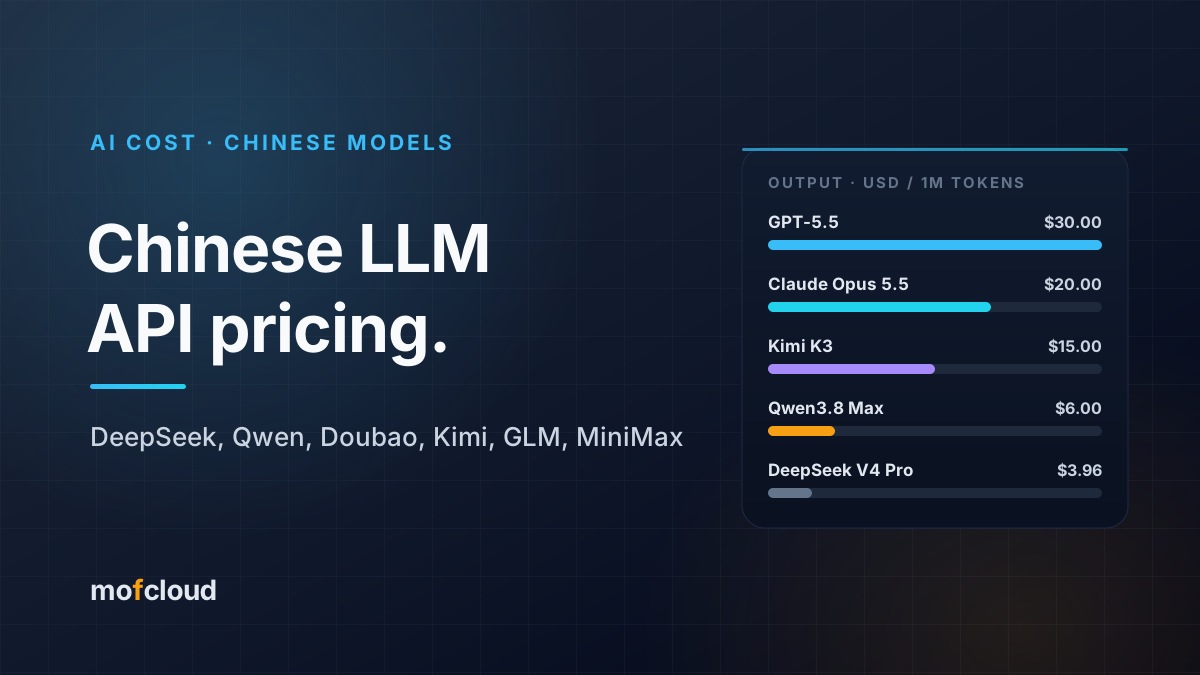
List prices per million tokens, standard real-time tier, as of November 19, 2026. CNY prices converted at 6.6672 CNY per USD (ECB rate, November 18, 2026).
| Model | Provider | Input | Cached input | Output | Notes |
|---|---|---|---|---|---|
| GPT-5.5 | OpenAI | $5.00 | $0.50 | $30.00 | Up to 272K input |
| GPT-5.4 mini | OpenAI | $0.75 | $0.075 | $4.50 | |
| Claude Opus 5.5 | Anthropic | $4.00 | $0.20 | $20.00 | |
| Claude Sonnet 5.5 | Anthropic | $2.00 | $0.10 | $10.00 | |
| Gemini 4 Argon | $2.00 | $0.10 | $10.00 | ||
| DeepSeek V4 Pro | DeepSeek | $1.32 | $0.044 | $3.96 | Peak; half off-peak |
| DeepSeek Flash | DeepSeek | $0.30 | $0.006 | $1.20 | Peak; half off-peak |
| Qwen3.8 Max | Alibaba Cloud | $2.00 | — | $6.00 | Singapore; $1.65 / $4.95 in Beijing |
| Qwen3.5 Flash | Alibaba Cloud | $0.10 | — | $0.40 | Singapore; $0.029 / $0.287 in Beijing |
| Doubao Seed 2.1 Pro | Volcengine | $0.90 | $0.18 | $4.50 | CNY 6 / 1.2 / 30 |
| Kimi K3 | Moonshot | $3.00 | $0.30 | $15.00 | CNY 20 / 2 / 100 |
| GLM-5.3 | Zhipu | $1.20 | $0.30 | $4.20 | CNY 8 / 2 / 28 |
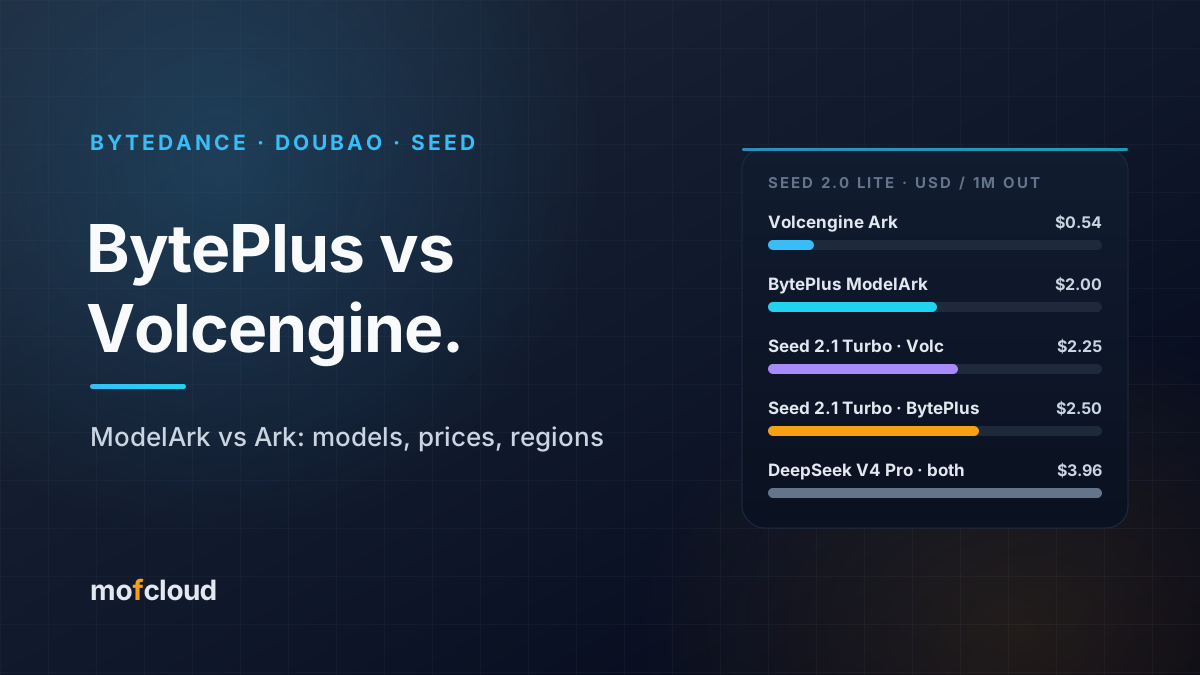
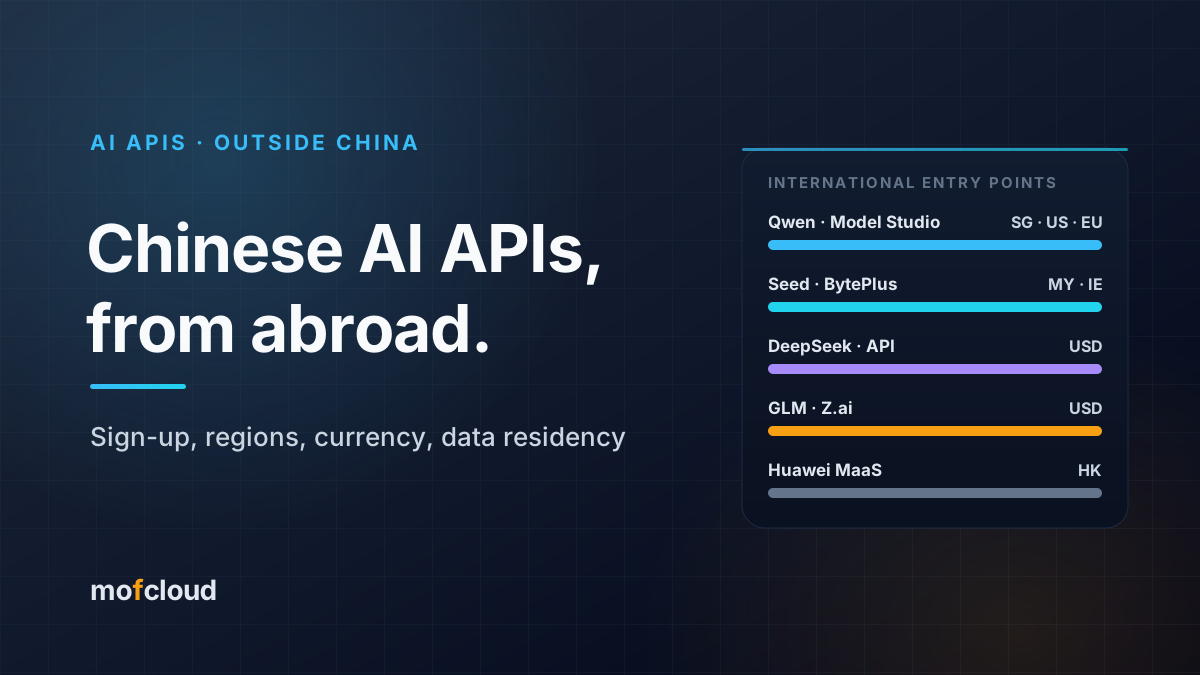
Sources: each provider’s pricing page, linked from the model pages on our LLM price comparison tool, which tracks 150+ models and refreshes daily. To price a specific workload, use the token cost calculator. For how DeepSeek, Qwen, Doubao, Kimi, GLM and MiniMax each bill, see Chinese LLM API pricing in 2026; for where to sign up from outside China, see how to use Chinese AI APIs from outside China.
Our take: the list price matters less than the five modifiers above. A team on Qwen in Singapore with no caching can easily pay more per task than a team on GPT-5.4 mini with an 80% cache hit rate. Compare cost per task from your own bills, not prices from a table, including this one.
Three ways to get one LLM cost number
| Gateway or proxy | Provider usage APIs | Cloud and provider bills | |
|---|---|---|---|
| How it works | Route every call through a proxy (LiteLLM, Portkey, Helicone and others) that logs tokens and estimates cost | Pull each vendor’s usage and cost endpoints on a schedule | Read billed cost from each provider and each cloud bill |
| Attribution | Per request, user, feature or tenant: the finest | Per key, project or workspace | Per key, workspace, account or tag |
| Accuracy | An estimate from a price table you maintain | Close, but some charges are excluded (for example Anthropic Priority Tier) | What you’ll actually pay, including discounts, credits and tax |
| Covers Chinese clouds | Only if every call goes through it | Only vendors with an API | Yes, model spend is on the cloud bill |
| Effort | Every app has to use it | A connector per vendor | A read-only key per account |
Use a gateway when you need cost per customer or per feature and control every call site. Use usage APIs for near-real-time alerts on OpenAI and Anthropic. Use the bills as the number finance signs off on. Most teams that spend real money on models end up with the bills as the ledger and a gateway or tags for attribution.
How Mofis tracks LLM spend
Mofis is our desktop app for cloud cost, with an AI cloud architect built in. For LLM spend it reads:
- OpenAI directly, with tokens and cost per model and per key.
- Model spend on the Chinese clouds from their bills: Alibaba Cloud Model Studio, Volcengine Ark (Doubao), Tencent Cloud, Huawei Cloud and Baidu AI Cloud Qianfan, broken down by model, key, and input, cached and output tokens, with the cache hit rate. We wrote up Model Studio in detail here.
- Models you buy through AWS, Azure or Google Cloud (Bedrock, Azure OpenAI, Vertex AI) as part of those cloud bills.
All of it sits in one table and one currency next to compute, storage and network, so AI spend shows up as a share of the whole bill rather than as an isolated token count.
What it doesn’t do today: Anthropic’s and DeepSeek’s own billing aren’t direct connectors in Mofis, and it doesn’t sit in the request path, so it can’t give you cost per end customer the way a gateway can. If most of your model spend goes straight to Anthropic, FinOps platforms such as Vantage, Finout, CloudZero and Harness connect to Anthropic and OpenAI; Mofis is the better fit when that spend sits next to Alibaba Cloud, Volcengine or other Chinese clouds.
A checklist for tracking LLM costs
- List every place you buy tokens: direct APIs, cloud marketplaces, and the model services inside each cloud.
- Issue one API key or workspace per application, so the bill can be split without a gateway.
- Record the deployment region for each model; on Qwen it can change the price by several times.
- Track cache hit rate and service tier alongside tokens.
- Pick a reporting currency, an exchange-rate rule and a tax treatment, and apply them to every provider.
- Reconcile one month of your tracked numbers against the actual invoices before anyone relies on them.
FAQ
How do I track OpenAI API costs by project or key?
Use the Costs API (/v1/organization/costs) with an organization admin key. It returns daily buckets you can group by project, line item or API key. Create one project or key per application so the split is meaningful.
Can I get Anthropic API costs programmatically?
Yes, through the Usage and Cost Admin API with an Admin API key. Usage is available by minute, hour or day and by model, workspace and key; cost is daily in USD. Priority Tier costs aren’t included in the cost endpoint, so track those through usage.
Is DeepSeek cheaper than OpenAI?
On list price, yes: DeepSeek V4 Pro is $1.32 input and $3.96 output per million tokens at peak, against $5 and $30 for GPT-5.5, and DeepSeek halves its prices off-peak. Whether it’s cheaper per task depends on output length, cache hit rate and how often you retry, so compare cost per task on your own workload.
Why is the same Qwen model cheaper in Beijing than in Singapore?
Alibaba Cloud Model Studio prices each deployment region separately. The China (Beijing) deployment is priced lower for many Qwen models, while the International (Singapore) deployment keeps inference outside mainland China and includes a free quota for new users. Choose based on data residency first, then price.
How do I combine CNY and USD LLM costs in one report?
Pick one reporting currency and a written exchange-rate rule (daily, monthly average or invoice date), and decide whether to compare tax-inclusive or pre-tax amounts, since Chinese China-site prices include VAT. We cover this in more detail in multi-cloud billing.
Want OpenAI, Qwen, Doubao and your cloud bills in one view? Mofis is free for one person, with a 14-day Pro trial and no card required.