Chinese LLM API pricing in 2026: how DeepSeek, Qwen, Doubao, Kimi, GLM and MiniMax charge
How DeepSeek, Qwen, Doubao, Kimi, GLM and MiniMax price their APIs in USD: caching, thinking tokens, prompt-length tiers, off-peak rates, vs GPT and Claude.
 MofCloud
Nov 19, 2026 · 10 min read
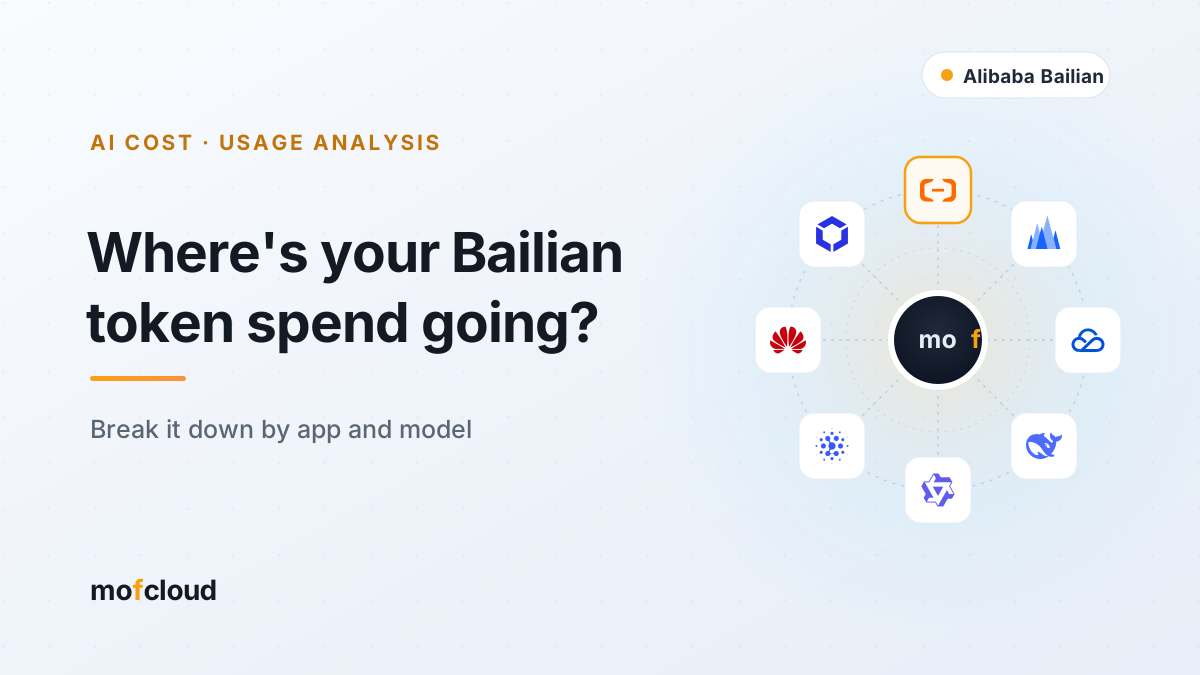
Chinese LLM APIs are cheaper than their US counterparts mainly on output: as of November 2026, the flagship models from DeepSeek, Zhipu (GLM) and Alibaba (Qwen) list at about $4–6 per million output tokens, against $10–30 for Claude, Gemini and GPT flagships. Input prices are closer, and Moonshot’s Kimi K3 is the exception: at $15 per million output tokens it costs more than Claude Sonnet 5.5. The bigger difference is how each provider bills: off-peak discounts, prompt-length tiers that reprice a whole request, separate prices for thinking mode, and cache storage fees. Those rules, not the headline rate, decide what you actually pay.
This post explains the billing rules model by model and compares the price bands. For live per-model prices we don’t paste a table that goes stale; we link to our LLM price comparison tool, which syncs official prices daily. Any number quoted below is marked with its date and source.
How much do Chinese LLM APIs cost per million tokens?
Here are the bands, in USD per million tokens, as of November 19, 2026. We use each provider’s international USD price list where one exists; Doubao Seed 2.1 Pro is sold only on Volcengine, so its CNY price is converted at 6.6672 CNY per USD (ECB rate, November 18, 2026).
| Tier | Chinese models (examples) | Typical input | Typical output | US comparison |
|---|---|---|---|---|
| Flagship | DeepSeek V4 Pro, GLM-5.3, Qwen3.8 Max, Kimi K3 | $1.30–3.00 | about $4–15 | Claude Opus 5.5 $4 / $20, GPT-5.5 $5 / $30 |
| Mid | Doubao Seed 2.1 Pro, Qwen Plus, MiniMax-M3 | $0.30–0.90 | $1.20–4.50 | Claude Sonnet 5.5, Gemini 4 Argon $2 / $10 |
| Flash | DeepSeek V4.1 Flash, GLM-5.3-Flash, Qwen Flash, MiniMax-M3.1-Flash | $0.05–0.30 | $0.40–1.20 | GPT-5.4 mini $0.75 / $4.50 |
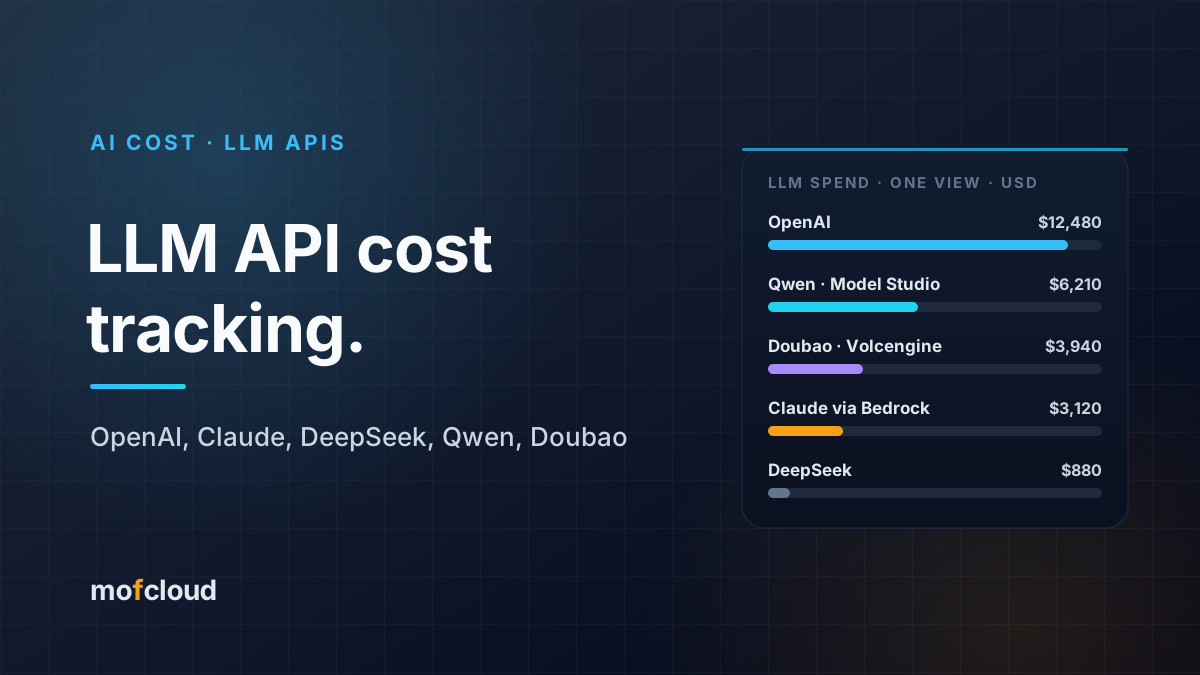
A few anchors from the official pages, as of November 19, 2026: DeepSeek V4 Pro is $1.32 input and $3.96 output at peak (DeepSeek pricing); GLM-5.3 is $1.40 and $4.40 on Z.ai (Z.ai pricing); Qwen3.8 Max is $2 and $6 in Alibaba Cloud’s Singapore region (Model Studio pricing); MiniMax-M3 is $0.30 and $1.20 for prompts up to 512K tokens (MiniMax pricing). US prices are from our LLM API cost tracking post, checked the same day.
In one line: Chinese flagships cost roughly a third to a fifth of US flagships per output token, and their flash tiers are cheaper still, but the gap varies a lot by model.
Why output price matters more than input price
Most comparisons lead with input price. For the workloads where Chinese models get chosen, that’s the wrong number to look at first.
Reasoning models write their chain of thought as output tokens, and agents generate long tool calls and code. On a coding agent, output can be a large share of the bill even though input tokens outnumber it, because output costs 3–6x more per token. That’s where the gap is widest: DeepSeek V4 Pro’s output is about 13% of GPT-5.5’s, while its input is about 26%. To compare two specific models on your own token mix, use a side-by-side page such as Kimi K3 vs Claude Opus 5.5 or DeepSeek V4 Pro vs Doubao Seed 2.1 Pro, or put your own numbers into the token cost calculator.
How each Chinese provider bills: the rules that change your cost
Every provider charges per million input and output tokens. What differs is everything around that. Here’s the summary, followed by the detail.
| Provider | Off-peak discount | Prompt-length tiers | Thinking mode priced separately | Cache pricing | Batch |
|---|---|---|---|---|---|
| DeepSeek | Yes, 50% | No | No | Cache hits about 2–3% of the input price | — |
| Alibaba Qwen (Model Studio) | No | Yes, whole request repriced | On some models | Explicit cache: write 125%, hit 10% of input | 50% |
| ByteDance Doubao (Volcengine / BytePlus) | Only on hosted DeepSeek | Yes, on Seed 2.0 models | No | Hits about 20% of input, plus an hourly storage fee | About 50% (Flex and Batch) |
| Moonshot Kimi | No | No | No | Automatic; K3 bills cache writes by TTL | 60% of standard |
| Zhipu GLM (Z.ai) | No | No | No | Hits about 20% of input; storage free for now | — |
| MiniMax | No | Yes, above 512K on M3 | No | Cache reads 10–20% of input | Priority tier costs 1.5x |
Sources: provider pricing pages linked in each section below, as of November 19, 2026.
DeepSeek: half price off-peak
DeepSeek’s two current API models, deepseek-v4-pro and deepseek-flash (served by DeepSeek V4.1 Flash), cost half as much off-peak. Peak hours are 01:00–04:00 and 06:00–10:00 UTC, Monday to Friday, and everything else is off-peak, including weekends and Chinese public holidays (DeepSeek pricing). That’s Beijing’s working day, so for a team in Europe or the Americas most daytime traffic is already off-peak.
Two more things are unusual. Cache hits are extremely cheap: $0.006 against $0.30 for a cache miss on Flash at peak, about 2%. And thinking mode is on by default, with no separate rate; DeepSeek bills the total input and output tokens. Usage is deducted from a prepaid balance, granted credit first.
Takeaway: with DeepSeek, when you run a batch job and how often you hit the cache move cost more than which model you pick.
Alibaba Qwen: region, prompt length and thinking all change the price
Qwen through Alibaba Cloud Model Studio has the most moving parts:
- Region. The same model has a different price in Singapore, the Chinese mainland (Beijing) and the “Global” deployments served from Hong Kong, Tokyo, Virginia and Frankfurt.
- Prompt-length tiers. Tiers are set by the total input tokens of a single request, and every token in that request is billed at that tier’s rate. On
qwen-plusin Singapore, crossing 256K input tokens triples the input price from $0.40 to $1.20. - Thinking mode. On some models it changes the output price:
qwen-plusoutput is $1.20 non-thinking and $4 thinking (up to 256K input, Singapore). On others, such asqwen-flashandqwen3.8-max, one price covers both. - Caching and batch. Creating an explicit cache costs 125% of the input price; hits cost 10%. Batch calls are 50% of real-time, and the two discounts don’t stack on the same tokens.
New Singapore users also get a free token quota per model, valid for 90 days. Our Bailian token cost post shows how to break the resulting bill down by model and key.
Takeaway: turning thinking on for a Qwen model can more than triple your output cost; check the model’s row before you flip it.
ByteDance Doubao: tiers, a cache storage fee, and two storefronts
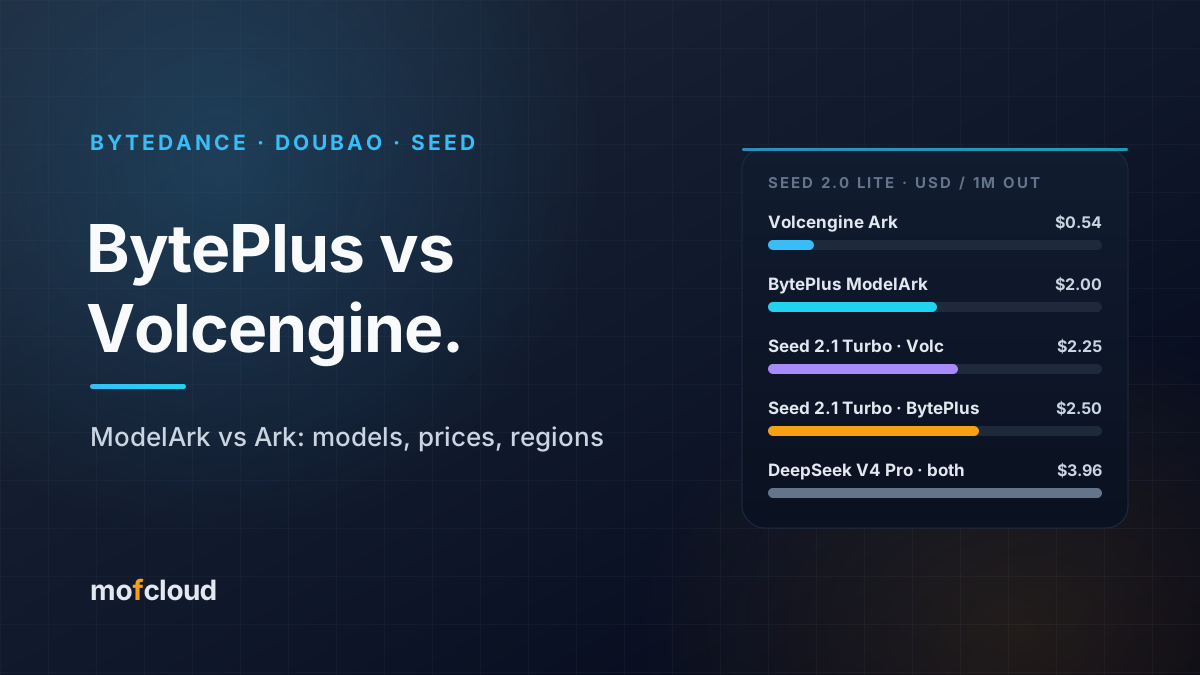
ByteDance sells its Seed (Doubao) models on Volcengine Ark in China, priced in CNY, and on BytePlus ModelArk internationally, priced in USD. The prices and tiers differ between the two, which we compare in BytePlus vs Volcengine.
The billing quirk to know is cache storage: on top of a discounted price for cache hits, you pay for cached tokens per hour ($0.0083 per million tokens per hour on BytePlus as of November 19, 2026). Seed 2.0 models also use prompt-length tiers, and ByteDance sells cheaper Flex and Batch tiers at roughly half the standard input and output price.
Takeaway: a long-lived cache on Doubao isn’t free; budget for storage if you keep big prefixes warm.
Moonshot Kimi: automatic caching and a cheaper batch tier
Kimi’s API platform turns on context-caching billing automatically for repeated prefixes, with a 5-minute default TTL. On K3 models, cache writes are billed separately by TTL (5 minutes or 1 hour), and Batch inference is 60% of the standard price. Prices exclude tax, which is calculated at checkout based on your jurisdiction. One thing to plan for: Moonshot says K2 models are closed to new users from October 31, 2026 and will be retired by the end of December 2026.
Kimi K3 is the expensive outlier among Chinese models. Its output price is above Claude Sonnet 5.5’s, so the reason to pick it is quality on long-context and agentic work, not cost. See the Kimi provider page for current K3 and K3.1 Pro prices.
Zhipu GLM: flat prices and free Flash models
Z.ai, Zhipu’s international platform, has the simplest price list: one input, cached-input and output price per model, in USD, with no length tiers. Cached-input storage is free for a limited time, and three small models (GLM-4.7-Flash, GLM-4.5-Flash and GLM-4.6V-Flash) are free to call.
Takeaway: GLM is the easiest of these to forecast, which matters more than a few cents per million tokens when finance asks for a budget.
MiniMax: a 512K tier and a priority lane
MiniMax-M3 doubles its price for prompts above 512K tokens, and a Priority tier, set with service_tier: priority, costs 1.5x Standard. MiniMax says the M3 prices include a permanent 50% discount (MiniMax pricing).
Do Chinese models cost the same inside and outside China?
Not always, and the direction isn’t consistent:
- DeepSeek charges the same USD prices on its own platform and on BytePlus ModelArk, which resells DeepSeek V4 Pro at $1.32 / $3.96 (BytePlus model pricing).
- GLM-5.3 is ¥8 / ¥28 on Zhipu’s China platform, about $1.20 / $4.20 at 6.6672 CNY per USD (ECB rate, November 18, 2026), against $1.40 / $4.40 on Z.ai. That’s roughly 5–17% more internationally.
- Qwen is often cheaper in Beijing than in Singapore. We gave a worked example in LLM API cost tracking.
- Doubao varies by model and tier: some Seed models cost more on BytePlus, and some long-prompt tiers cost less.
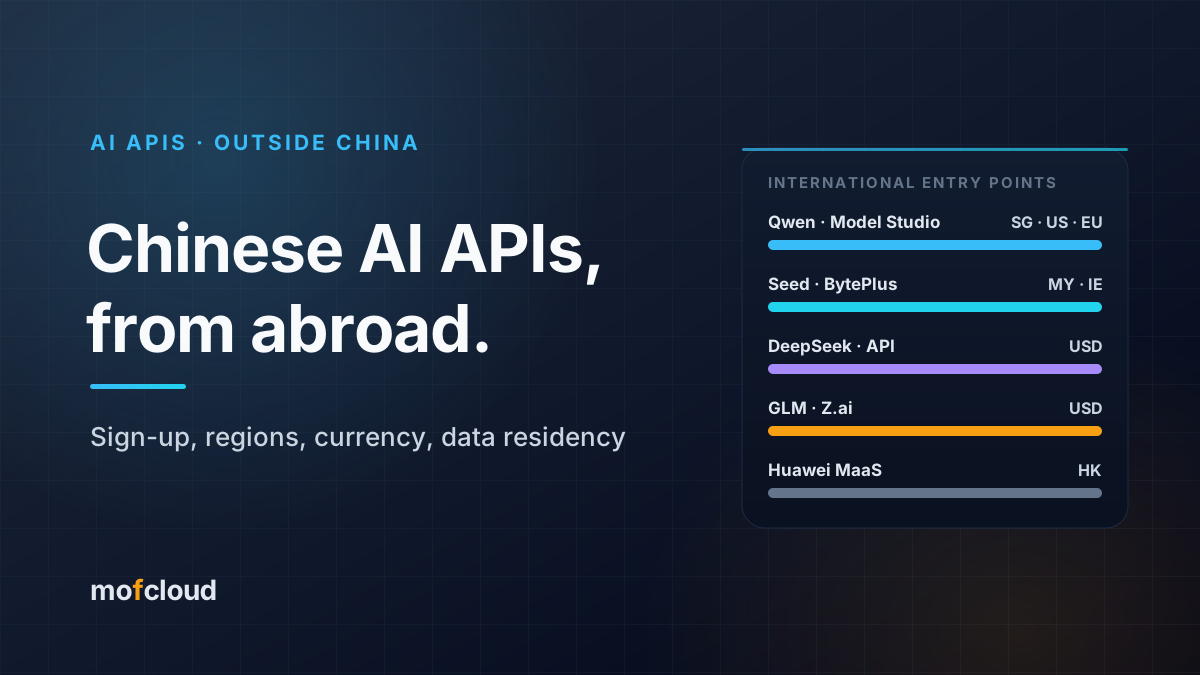
China-site prices are usually in CNY and often include VAT, while international prices are in USD before tax, so compare like with like. If you’re buying from outside China, start with how to use Chinese AI APIs from outside China, because the entry point you can actually sign up for decides which price applies to you.
Which Chinese model API is cheapest for your workload?
Our take, from watching these price lists move all year:
- High-volume, latency-tolerant jobs (batch classification, extraction, evals): DeepSeek V4.1 Flash off-peak, or a free GLM Flash model if quality is enough. Scheduling the job outside Beijing’s peak hours halves the cost on DeepSeek.
- RAG with long, stable prefixes: a provider with cheap cache hits. DeepSeek’s hit price is tiny; on Doubao, factor in storage.
- Long-context requests above 128K–256K: avoid models whose tier repricing applies to the whole request, or keep prompts under the threshold. Check the tier table before you scale a context window.
- Agents and coding: compare output prices and the cost of thinking. GLM-5.3 and DeepSeek V4 Pro sit around $4 per million output tokens; Kimi K3 is around three times that.
- Predictable budgets: GLM on Z.ai, with flat per-model prices.
None of this replaces measuring cost per task on your own traffic. A model that’s half the price but needs two retries isn’t cheaper.
Where to check live Chinese LLM prices
Chinese providers change prices often. DeepSeek alone changed its lineup in September 2026. Check these pages before you commit to a budget:
- LLM price comparison: 170+ models, synced daily from official pages.
- Provider pages: DeepSeek, Alibaba Cloud (Qwen), ByteDance (Doubao), Moonshot (Kimi), Zhipu (GLM), MiniMax, Huawei Cloud MaaS, Tencent Hunyuan, Baidu Qianfan.
- LLM API price comparison and the token cost calculator to price a workload.
Once the bills arrive, Mofis, our desktop app, reads model spend from Alibaba Cloud, Volcengine, Tencent Cloud, Huawei Cloud and Baidu bills alongside OpenAI and your AWS, Azure and Google Cloud costs, so a Qwen or Doubao line sits next to the rest of your cloud spend in one currency.
FAQ
Is DeepSeek cheaper than GPT and Claude?
On list price, yes. As of November 19, 2026, DeepSeek V4 Pro is $1.32 input and $3.96 output per million tokens at peak, and half that off-peak. GPT-5.5 is $5 and $30, and Claude Opus 5.5 is $4 and $20. Cost per task also depends on output length, retries and cache hit rate.
Which Chinese LLM API is the cheapest?
At the paid flash tier, DeepSeek V4.1 Flash off-peak ($0.15 / $0.60), Qwen Flash and GLM-5.3-Flash are all well under $1 per million output tokens. Z.ai also offers three GLM Flash models free. The cheapest option for you depends on which of these meets your quality bar.
Do thinking tokens cost extra on Chinese models?
They’re billed as output tokens. On DeepSeek, GLM, Kimi and Doubao there’s no separate thinking rate. On some Qwen models, such as qwen-plus, thinking mode has a higher output price than non-thinking.
What is prompt-length tiered pricing?
Some providers, including Alibaba Qwen, ByteDance Doubao and MiniMax, set the price by the total input length of each request. When a request crosses a threshold, all of its tokens are billed at the higher tier, not only the tokens above the threshold.
Are Chinese LLM prices in USD or CNY?
Both. International platforms (DeepSeek’s API, Alibaba Cloud international, BytePlus, Z.ai, Kimi, MiniMax) price in USD, usually before tax. China-site platforms (Volcengine, Bigmodel, Alibaba Cloud China) price in CNY. Our LLM price comparison shows each model in its source currency.
Want Qwen, Doubao and OpenAI spend next to your cloud bills? Mofis is free for one person, with a 14-day Pro trial and no card required.