


Is AI really cheaper than people? Five hidden costs (2026)
Everyone assumes replacing people with AI saves money. Tokens are cheap — but the real bill hides in five places most comparisons skip. We run the numbers with Chinese salaries and Chinese model prices, using one engineering team as the worked example.
 MofCloud
 A founder with ¥10M in annual revenue does the math: payroll is the big line item, AI is clearly where things are headed, so cut a few roles, hand the work to AI, and the savings should follow. Right?
That’s almost everyone’s default assumption — replace people with AI, spend less. Token prices really are low. But that’s the smallest cell on the bill. What actually decides whether you save is five costs you can’t see. This post runs the numbers with Chinese salaries and Chinese model prices, using one engineering team as the example.
The short answer
- Token prices really are low. The cheap Chinese models cost roughly 1–3% of GPT-4o’s per-token output price, and even the domestic flagships undercut GPT-4o and Claude several times over.
- Whether you actually save depends on five hidden costs: someone has to watch the AI, your team has to be good at using it, the switch itself is painful, the smartest models keep getting pricier, and the people who make AI work well are scarce and expensive.
- The answer is different in China than in the US. The American “AI is cheaper” pieces stack it up against reviewers who cost tens of dollars an hour. In China, that review labor is far cheaper — and the models are cheaper too. Both sides of the equation change, so the conclusion changes.
- Bottom line: where labor is cheap, the right mix usually beats outright replacement — especially for small companies. Replacing people with AI rarely erases the human cost; more often it just moves it to a pricier, harder-to-hire role.
How cheap are the tokens, really?
Let’s settle this first, because it’s true. Prices below are from each vendor’s official page, as of August 2026 (¥ per 1M tokens; these move fast, so check the source):
- Cheap workhorses — Qwen flash, Doubao flash, GLM Air, Ernie Turbo: input ¥0.15–0.8, output ¥0.8–3.2, with several offering a free tier.
- Domestic flagships — DeepSeek, GLM, Doubao top models: output around ¥13–30.
- Overseas benchmark — GPT-4o output ~¥72, Claude Sonnet ~¥108.
Run a batch of routine tasks and the model line might cost you a few cups of coffee. So yes, tokens are cheap. The catch: it’s the smallest line on the bill. The next five are where the money actually goes.
Hidden cost 1: someone has to watch the AI — forever
AI works fast and cheap, but it also gets things wrong — a lot. Any task where a mistake is expensive and hard to undo needs a human watching.
- The rule: let a human watch only when the cost of watching is less than the cost of a mistake.
- Safe to automate: high-volume, low-risk work (internal drafts, tagging) — hand it fully to AI.
- Can’t drop the human: anything customer-facing, financial, compliance-related, or that changes a live system.
- Don’t forget: reviewers, annotators, and support staff in China run about ¥25–65/hour — cheap, but not zero. The more AI does, the more there is to review, so this bill grows with usage.
Hidden cost 2: your team’s skill with AI matters more than the AI itself
Buying AI isn’t the same as using it well.
- Used ≠ got value: over 90% of white-collar workers have used AI (Maimai 2025), but among the ~46% of Chinese companies scaling generative AI, only about 9% capture real value (Accenture 2025).
- Closing that gap costs money: the skills gap is the top barrier (McKinsey); training one person runs roughly ¥3,500–20,000 (estimated from course list prices — no reliable national average exists).
- The payoff goes to the skilled: one case reports ~+11% R&D efficiency (Alibaba Cloud, vendor figure) — but only for teams that know how to use it.
Hidden cost 3: the transition dip can wipe out ten times your savings
Cut staff, switch to AI, and payroll looks great immediately. Then the next six months tend to hurt — people leave, knowledge walks out the door, production breaks, shipping slows. Economists call this the productivity J-curve (Brynjolfsson et al., NBER 2018): output usually dips before it rises, and you have to cross the trough first.
Illustrative math on the ¥10M-revenue company (scenario estimate, not measured):
- Lost knowledge: replacing one person costs about 0.5–2× their annual salary (Gallup 2019).
- Churn during the rough patch: slower shipping plus a few incidents. Lose even 5–15% of half a year’s revenue and that’s ¥250k–750k.
- For comparison: a year of token savings might be a few tens of thousands.
One painful transition can eat ten times what you saved on tokens.
Worth noting: transformations don’t win just by starting. Only about 16% improve performance and keep the gains (McKinsey). The popular “70% of transformations fail” line has no solid source — ignore it — but “success is the exception” holds up.
Hidden cost 4: the smarter the model, the more it costs — and the more tokens it burns
“AI just keeps getting cheaper” is half right.
- The true half: for a fixed capability, prices are falling hard (Zhipu’s GLM flagship went from ¥50 to ¥5 per million in half a year).
- The other half — your bill still climbs, for two reasons:
- people default to the strongest model for everything, paying a premium on every task;
- smarter models burn far more tokens (they reason at length, or take multi-step actions on their own) — a single task can cost several, even dozens of times what a plain model would.
- In one line: the price of “smart” is dropping, yet your bill keeps rising.
- The way out: give a cheap model good scaffolding (route by task, add a knowledge base, add automated checks) so it can hold its own against a smart one — except almost nobody does the work, and that’s hidden cost 5.
Hidden cost 5: the people who make AI work are scarce and expensive
The way out above — build scaffolding so a cheap model does a smart model’s job — is itself scarce, expensive labor.
- Scarce: engineers who can build this (routing, knowledge bases, evals, agent workflows) are thin on the ground. The supply/demand ratio for LLM-algorithm roles is about 0.17 — roughly six openings per candidate (Liepin 2025).
- Expensive: new LLM-algorithm postings average ¥70,107/month (NBD 2025); AI scientists ~¥127k/month; Beijing pegs a median “AI model architect” at ¥42k/month.
- Growing your own isn’t cheap either: it’s slow and costly, and once trained they get poached (add another replacement cost).
- It cuts both ways: don’t build, and you pay the “use the strongest model” premium on every task forever; do build, and you sink a large, scarce-talent cost up front, betting it pays back in lower token bills.
A worked example: an engineering team adopts AI
The five costs get concrete inside one scenario. Say a 10-person backend team (1 lead, 6 mid/senior, 3 junior), roughly ¥300k/month in payroll. The plan: adopt AI coding, cut the 3 juniors, save ¥60k/month.
What you save:
- Tokens are pocket change. Ten people coding on a cheap Chinese model might spend ¥1,000–3,000/month on tokens.
- The productivity lift is real — if the team knows how to use it (see the +11% case).
What you add:
- Cost 4 — default to the strongest overseas model plus agents, and the token bill can jump from a few thousand to ¥10k–30k/month.
- Cost 1 — AI code needs review. Mid/senior engineers spend more time each day checking AI’s output, eating into the gains.
- Cost 2 — a team that can’t use it well captures almost none of the +11%, and may create noise.
- Cost 3 — the 3 cut juniors owned modules nobody else understands, so bugs and slow shipping follow. Lose a customer or refund a contract and it can dwarf the ¥360k saved over six months.
- Cost 5 — to make a cheap model reliably write your code (instead of brute-forcing it with an expensive one) you need someone to set internal conventions, build a knowledge base, and add automated checks. That person costs ¥340–560/hour and is hard to hire.
| The line item | Direction | Yearly impact (illustrative) |
|---|---|---|
| Tokens cheaper than people | Save | Very low token spend; real lift (if used well) |
| AI code needs review (cost 1) | Add | Mid/senior review hours |
| Training the team (cost 2) | Add | ¥3.5k–20k/person + time |
| Transition dip / lost knowledge (cost 3) | Add | Single to double-digit % of half-year revenue |
| Defaulting to the smartest model (cost 4) | Add | Token bill up several fold |
| Scarce scaffolding talent (cost 5) | Add | ¥340–560/hr, and hard to hire |
The tally: tokens are the small money. The real spend lands in review hours, training, the transition dip, and that scarce person who builds the scaffolding. The +11% lift is real — but it’s a reward for teams that build and use AI well, not a rebate you collect by cutting headcount.
A cost ladder: replacing people often just moves the cost up
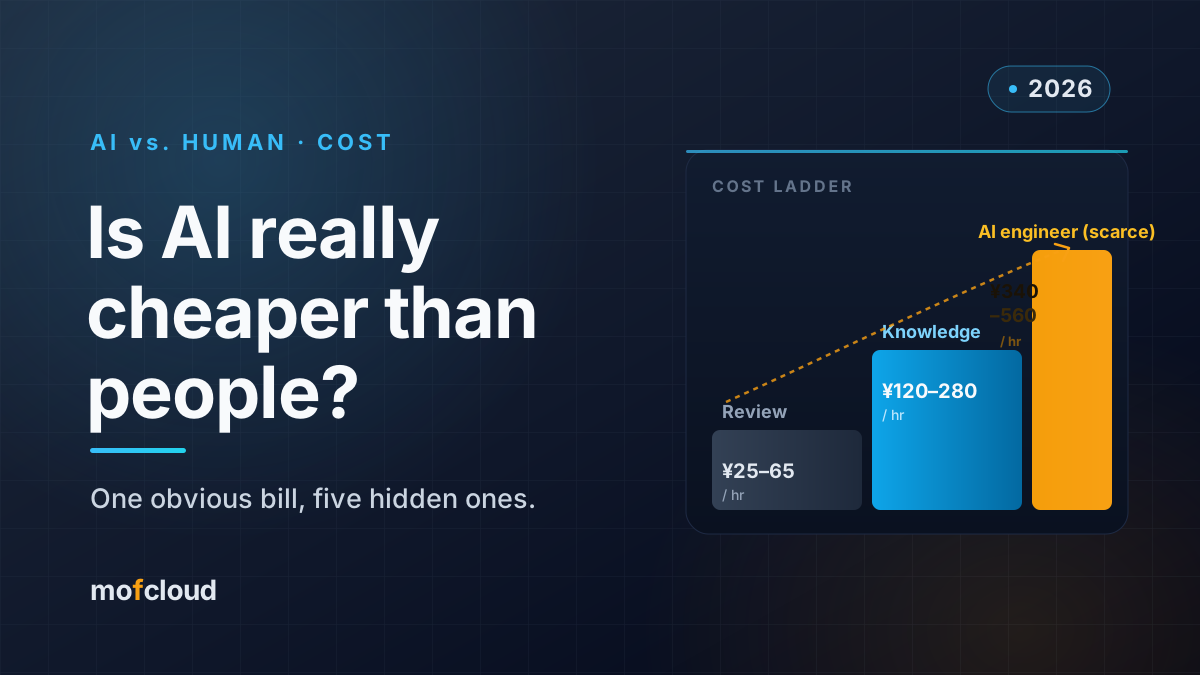
Put those labor costs side by side (fully-loaded hourly ≈ monthly ×1.4 ÷ 174, covering social insurance and overhead; the same role varies a lot by city and seniority, so these are order-of-magnitude bands from job-posting data, treated as approximate):
| Tier | Typical roles | Fully-loaded ¥/hour (order of magnitude) |
|---|---|---|
| Human review | Moderation / annotation / support | ¥25–65 (~$3.5–9) |
| Knowledge work | PM / engineer / project manager | ¥120–280 (~$17–39) |
| Scaffolding talent (scarce) | LLM / AI engineer | ¥340–560 (~$47–78) |
Here’s the point: you drop a few ¥25–65/hour review seats, but often need one ¥340–560/hour engineer to make the AI actually run. Replacing people with AI frequently doesn’t erase the human cost — it moves it up to a pricier, harder-to-hire tier. Whether that pays depends on your volume and company size, not on how cheap the tokens are.
(Note: this compares hourly rates, not a claim that one AI engineer replaces several reviewers. Small companies often hire no scaffolding role at all — the founder absorbs that cost as their own time.)
So how should you mix it? By company size
The question was never “AI or people.” It’s: which task, at what volume, with a team of what skill level, at what size of company. A framework:
| Company size | Play | Who reviews | Model choice | Watch out for |
|---|---|---|---|---|
| Small / startup | AI as an amplifier — don't rush to replace | Founder or core does it | Cheap tier + self-serve tools; don't build scaffolding you can't staff | Transition risk is largest as a share of revenue |
| Mid | High-volume to AI, judgment to people | Dedicated reviewer, by risk tier | Mostly cheap; flagships only for the hard tasks | Start costing review and training seriously |
| Large | Scale up, tier by risk | Dedicated team + process | Route by task | Frontier premium + tokens quietly spiraling |
Two more axes sharpen the call. Reversibility: if a mistake can’t be undone, is customer-facing, or high-risk, keep a human on it; if it’s editable, internal, and low-risk, automate. Volume: at low volume people are often cheaper (no setup or review overhead); only past a certain scale does AI’s per-unit edge win out.
For small companies the takeaway is sharpest: you can’t afford the scaffolding role and you’re the most tempted to default to the priciest model — so lean on AI as an amplifier, keep the mix light, and don’t try a replacement you can’t sustain.
A few suggestions
- Measure before you move. Know where your tokens go — which product, model, and task — before you optimize. You can’t cut a cost you can’t see.
- Pick the model per task; don’t default to the strongest. Save the flagship for genuinely hard work.
- Keep a human on the irreversible stuff; fully automate only the high-volume, reversible work.
- Don’t lead with layoffs. Let your existing people do more with AI, watch a quarter or two, then decide on headcount.
- Treat the productivity lift as a capability to build, not a feature to buy. Train people, build the knowledge base — the +11% goes to teams that can use it.
Before you decide any of this, make the bill visible
All five hidden costs share a trait: most of them are invisible. Which product, model, or task is driving your AI spend? Which slice is quietly climbing? Most teams can’t say — and a cost you can’t see is a cost you can’t cut.
That’s why we build MofCloud: to make cloud and AI spend visible and attributable — Alibaba, Tencent, Huawei, Volcengine, Baidu, plus AWS, Azure, and GCP in one view, with the token cost of DeepSeek, Qwen, GLM, and Kimi in the same picture. Turn the hidden bills into visible ones first; optimization comes after. Once the numbers are in front of you, whether to replace people with AI is your call.
FAQ
Is AI actually cheaper than people? On tokens alone, yes. Add human review, training, the transition dip, and scaffolding talent, and it’s not a given. High-volume, reversible work favors AI; low-volume, high-risk, judgment work often favors people.
Why is the answer different in China than in US articles? US pieces compare against reviewers costing tens of dollars an hour; in China that work runs tens of RMB an hour, and the models are cheaper too. With both sides lower, the break-even point moves — where labor is cheap, mixing usually beats replacing.
Should a small company replace people with AI? Better to treat AI as an amplifier than a replacement. Small companies carry the largest transition risk relative to revenue and can least afford scarce scaffolding talent. Cheap models and self-serve tools that help your existing people do more are the safer bet.
Why does the bill rise even as per-token prices fall? Because people default to the smartest model, and smarter models burn several times the tokens per task (they reason at length and run their own steps). Unit price drops, per-task consumption rises faster, so the bill goes up. The fix is routing by task plus good scaffolding.
Current as of August 2026. Model prices and salary bands move quickly — check each vendor’s official page and current hiring data. Figures marked “illustrative” or “estimated” are scenario math, not measured results. Check against your own business before deciding.
Related
Content · 18 Aug, 2026
Why cloud costs spiral out of control
Company · 19 Aug, 2026
Beyond the dashboard: FinOps needs judgment, not just visibility
Feature · 20 Aug, 2026
Meet Mof: multi-cloud cost, one clear view
Content · 21 Aug, 2026
FinOps tools for Chinese clouds: Alibaba, Tencent, Volcengine & Huawei (2026)
Content · 22 Aug, 2026
Your AWS is through a reseller? How to still get your cost data
All your multi-cloud costs, in one place
The dashboard is ready to self-host; the cloud architect Agent is coming — join the waitlist for early access.