


Meet Mof: multi-cloud cost, one clear view
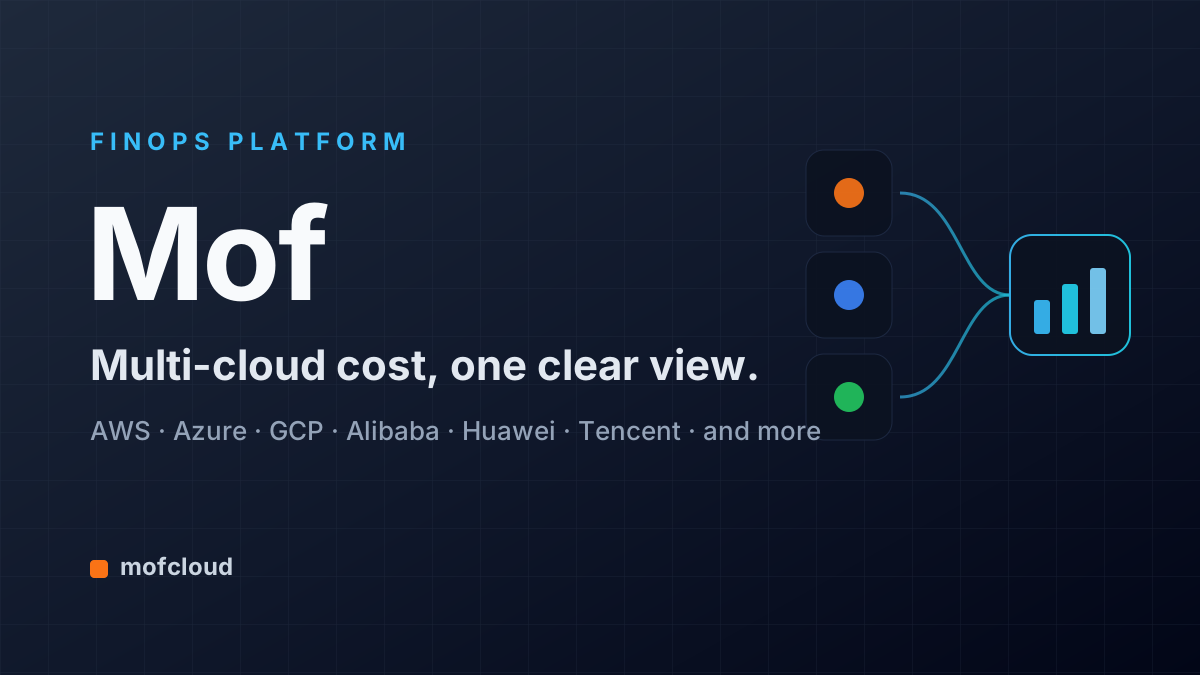
One dashboard for every cloud bill — normalized cost, allocation, and anomaly detection across AWS, Azure, GCP, Alibaba, and more. Plus Mofis, the cloud architect Agent that reads your live bills.
 MofCloud
 Most teams didn’t decide to go multi-cloud. It happened: an acquisition here, a region requirement there, a data pipeline that runs cheapest somewhere else. Before long the bill lives in five consoles, three currencies, and no two of them agree on what a “line item” even means.
Mof is our answer to that mess — one place to see, allocate, and act on cloud cost, no matter how many providers you run.
One normalized view across every cloud
Mof pulls billing directly from AWS, Azure, Google Cloud, Alibaba Cloud, Huawei Cloud, Tencent Cloud, Volcengine, Oracle, Cloudflare, and more, then normalizes it into a single model. Service names, charge types, regions, tags — mapped into one vocabulary so a dollar on AWS and a yuan on Alibaba land in the same report.
That means you can finally answer the questions that used to require a spreadsheet and a long afternoon:
- What did this team spend last month, across all clouds?
- Which services are growing fastest — and is it usage or price?
- Where is the same workload cheaper on another provider?
Allocation that survives real org charts
Raw spend isn’t the hard part; attributing it is. Mof gives you cost allocation rulesets, tag and virtual-tag hierarchies, and shared-cost splitting, so support, networking, and platform costs land on the teams that actually caused them. Set the rules once; they re-apply every month, even as accounts and tags drift.
Catch problems before the invoice does
Mof watches for anomalies as the data lands — a NAT gateway that quietly 10בd, a forgotten cluster, a storage class gone wrong — and can send scheduled reports and alerts to the channels your team already lives in. You find out on the 3rd, not on the invoice.
And because Mof is self-hostable, your billing data never has to leave your environment.
What’s next: Mofis, the cloud architect Agent
A dashboard tells you what happened. The harder question is what to do about it — and that usually takes a cloud architect who can read a bill in context.
That’s Mofis. It reads your live billing and resource data — not static docs — and returns judgment: where you’re overspending, what to right-size or commit, and the architecture-level moves that actually move the number. It’s the layer between “here’s your cost” and “here’s the fix.”
Mofis is coming soon. If that’s the part you’ve been waiting for, join the Agent waitlist below — early access goes out first to teams already running Mof.
The dashboard is ready to self-host today. The Agent is on its way. Either way, the goal is the same: multi-cloud cost you can actually reason about — in one clear view.
Related
Content · 18 Aug, 2026
Why cloud costs spiral out of control
Company · 19 Aug, 2026
Beyond the dashboard: FinOps needs judgment, not just visibility
Content · 21 Aug, 2026
FinOps tools for Chinese clouds: Alibaba, Tencent, Volcengine & Huawei (2026)
Content · 22 Aug, 2026
Is AI really cheaper than people? Five hidden costs (2026)
Content · 22 Aug, 2026
Your AWS is through a reseller? How to still get your cost data
All your multi-cloud costs, in one place
The dashboard is ready to self-host; the cloud architect Agent is coming — join the waitlist for early access.