Kimi K3 API pricing: K3 vs K3.1 Pro, caching, batch, and how it compares to Claude and DeepSeek
Kimi K3 costs $3 input and $15 output per million tokens; K3.1 Pro costs $2 and $10. Cache writes, the 1-hour TTL, batch at 60%, and the price vs Claude, GPT and DeepSeek.
 MofCloud
Nov 22, 2026 · 8 min read
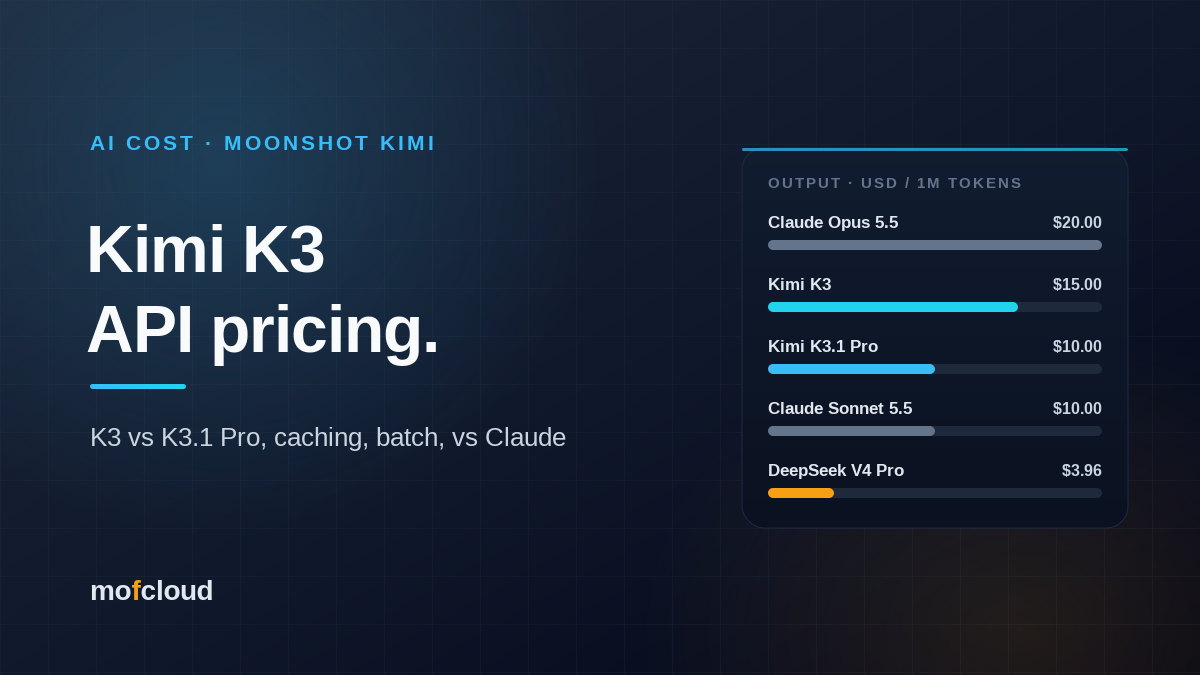
As of November 22, 2026, the Kimi K3 API costs $3.00 per million input tokens and $15.00 per million output tokens, with cached input at $0.30. Its successor, Kimi K3.1 Pro, is cheaper: $2.00 input and $10.00 output, the same list price as Claude Sonnet 5.5. A faster variant, K3.1 Pro Highspeed, costs twice as much as K3.1 Pro. All three have a 1M-token context window, bill cache writes by TTL, and run at 60% of the standard price through the Batch API (Highspeed excepted). Source: Moonshot’s pricing page.
If you’re on K3 today, the short version is: K3.1 Pro costs a third less on every line and Moonshot reports it as the stronger model. There’s little reason to start new work on K3.
For live prices across 150+ models, see our LLM price comparison; the numbers below were checked on the official page on the date above.
How much does the Kimi K3 API cost per million tokens?
Moonshot sells three K3-series models on its international platform, priced in USD per million tokens (MTok):
| Model | Input | Output | Cached input | Cache write, 5 min | Cache write, 1 hour | Context |
|---|---|---|---|---|---|---|
Kimi K3 (kimi-k3) |
$3.00 | $15.00 | $0.30 | $3.00 | $6.00 | 1,048,576 |
Kimi K3.1 Pro (kimi-k3.1-pro) |
$2.00 | $10.00 | $0.20 | $2.00 | $4.00 | 1,048,576 |
Kimi K3.1 Pro Highspeed (kimi-k3.1-pro-highspeed) |
$4.00 | $20.00 | $0.20 | $4.00 | $8.00 | 1,048,576 |
Source: Kimi API model pricing, as of November 22, 2026. Prices exclude tax.
There are no prompt-length tiers: a 900K-token request is billed at the same rate per token as a 9K-token one. That’s a real difference from Qwen and Doubao, which reprice the whole request once it crosses a length threshold (we cover those in Chinese LLM API pricing). There’s no separate thinking-mode price either. K3.1 Pro always thinks; you set how hard with reasoning_effort (low, high or max, default max), and the reasoning tokens bill as output.
On Moonshot’s China platform the same models are sold in CNY; our tool lists Kimi K3 at ¥20 input and ¥100 output, which is about the USD price at the current exchange rate.
In one line: Kimi K3 is $3 / $15, K3.1 Pro is $2 / $10, and Highspeed doubles K3.1 Pro for 2–3x the speed.
Is Kimi K3.1 Pro cheaper than K3?
Yes, by a third on input, output, cached input and both cache-write tiers. K3.1 Pro is a post-trained version of K3 released in October 2026, and Moonshot reports it ahead of K3 on its own coding benchmark (61.2% vs 55.95% on Kimi Code Bench 3.0 Long-horizon) and with a much lower hallucination rate on its internal stress test (K3.1 Pro guide). These are vendor-reported numbers, so test on your own workload, but on price alone the newer model wins.
Two things to know before you switch:
- K3.1 Pro always thinks. If you were calling K3 with low reasoning effort to save output tokens, set
reasoning_effort: "low"on K3.1 Pro too, or your output bill can grow even at the lower rate. - Access needs a top-up. K3.1 Pro unlocks after a successful recharge of at least $1.
Takeaway: for new work, start on K3.1 Pro; keep K3 only where you’ve validated its output and don’t want to re-test.
What does Kimi K3.1 Pro Highspeed cost, and when is it worth it?
Highspeed is exactly 2x K3.1 Pro on input, output and cache writes, for what Moonshot describes as 2–3x the speed. Cached input stays at $0.20, the same as standard K3.1 Pro.
That makes it a latency purchase, not a quality one. It’s worth it for interactive coding agents and chat UIs where a user waits on every token. For background jobs, the standard model, or better the Batch API at 60%, gets the same answers for less.
How does Kimi’s context caching work, and how is it billed?
Kimi caches repeated request prefixes automatically; you don’t create a cache object. What you choose is how long a written prefix stays cached:
- 5-minute TTL (default). The write price equals the normal input price ($2.00 on K3.1 Pro), so caching costs nothing extra, and any request that reuses the prefix within five minutes pays $0.20 instead of $2.00 for it.
- 1-hour TTL (set
prompt_cache_options.ttl). Writes cost double the input price ($4.00 on K3.1 Pro).
Moonshot’s rule is that cache hits are billed at the cached-input price only, with no extra write charge on top (pricing page).
Here’s our take on when the 1-hour TTL pays off. With the 5-minute default, a prefix reused after a 10-minute gap has expired and gets written again at the full input price. With a 1-hour TTL, you pay one extra input-price’s worth up front, then each reuse within the hour costs 10% of input instead of 100%. So if a prefix is reused even once more within the hour, after more than five minutes have passed, the 1-hour TTL has already paid for itself. That’s the normal pattern for a coding agent working on one repo through a session, or a support bot with a long system prompt and bursty traffic. For a steady stream of requests seconds apart, the default is enough.
How much does Kimi K3 cost compared with Claude, GPT and DeepSeek?
List prices per million tokens, as of the dates noted:
| Model | Input | Output | Cost of 30M input + 10M output |
|---|---|---|---|
| Kimi K3.1 Pro | $2.00 | $10.00 | $160 |
| Kimi K3 | $3.00 | $15.00 | $240 |
| Kimi K3.1 Pro Highspeed | $4.00 | $20.00 | $320 |
| Claude Sonnet 5.5 | $2.00 | $10.00 | $160 |
| Claude Opus 5.5 | $4.00 | $20.00 | $320 |
| GPT-5.5 | $5.00 | $30.00 | $450 |
| Qwen3.8 Max (Singapore) | $2.00 | $6.00 | $120 |
| GLM-5.3 (Z.ai) | $1.40 | $4.40 | $86 |
| DeepSeek V4 Pro (peak) | $1.32 | $3.96 | $79 |
Kimi prices are from November 22, 2026; the rest are from the official pages as of November 19, 2026, listed in our Chinese LLM API pricing post. The last column uses list prices only, no caching or batch.
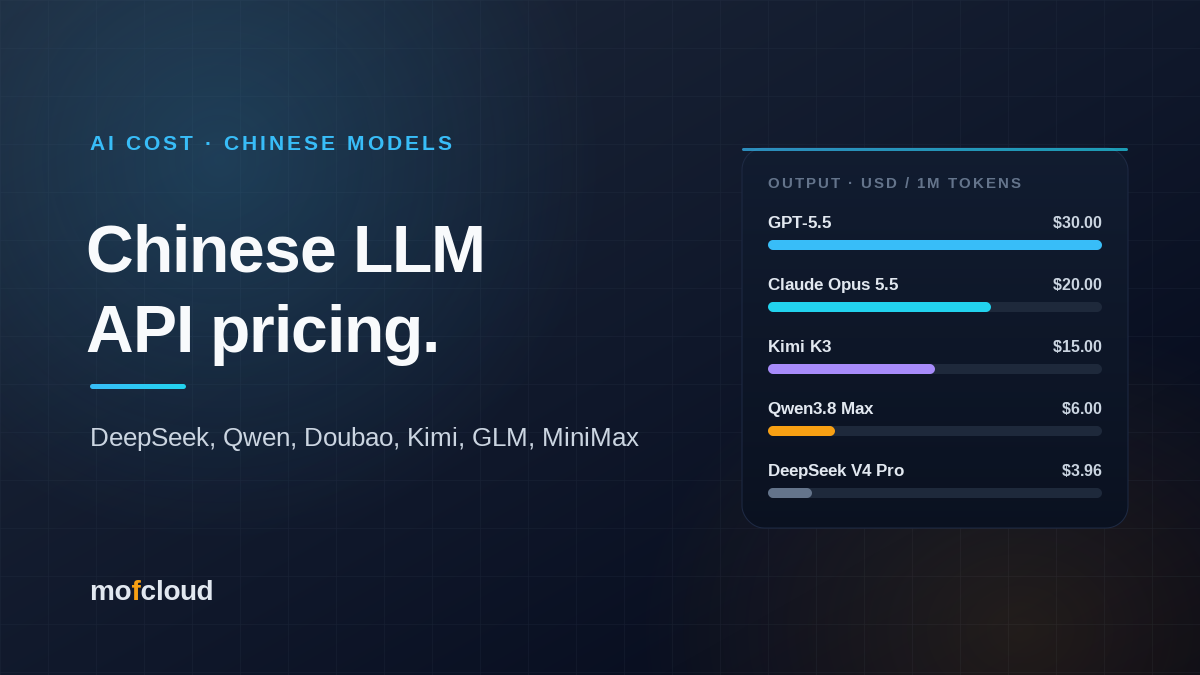
Kimi doesn’t fit the “Chinese models are cheap” story. K3.1 Pro is priced exactly like Claude Sonnet 5.5, and Highspeed exactly like Claude Opus 5.5. DeepSeek V4 Pro and GLM-5.3 cost about half as much as K3.1 Pro for the same token mix, and DeepSeek halves again off-peak. Moonshot is pricing Kimi as a frontier model, not a discount alternative: on Terminal-Bench 4.0 it reports K3.1 Pro at 65.7%, against 66.4% for Claude Opus 5.5.
So the comparison that matters for Kimi is quality per dollar against Sonnet and Opus, not price against DeepSeek. To run your own token mix, use a side-by-side page such as Kimi K3 vs Claude Opus 5.5 or DeepSeek V4 Pro vs Kimi K3.1 Pro, or the token cost calculator.
How much can caching and batch save on Kimi?
A worked example: a coding agent that sends 100M input tokens a month, 70% of them cached prefixes, and gets 10M output tokens back.
| Setup | Input (30M uncached) | Cached input (70M) | Output (10M) | Monthly total |
|---|---|---|---|---|
| Kimi K3 | $90 | $21 | $150 | $261 |
| Kimi K3.1 Pro | $60 | $14 | $100 | $174 |
| Kimi K3.1 Pro, no caching | $200 | — | $100 | $300 |
Uncached input is billed at the 5-minute write price, which equals the input price. Moving the same workload from K3 to K3.1 Pro saves a third; caching then cuts the K3.1 Pro bill from $300 to $174, a 42% saving. Notice that output is the biggest line in every row: on reasoning models the thinking tokens are output, so reasoning_effort is a cost setting as much as a quality one.
The Batch API takes another 40% off for jobs that don’t need an answer right away: evals, document backfills, nightly code review. Batch runs at 60% of the standard price on kimi-k3 and kimi-k3.1-pro; cache hits in batch are best-effort, so don’t count on them.
Minimum top-up, vouchers and rate limits
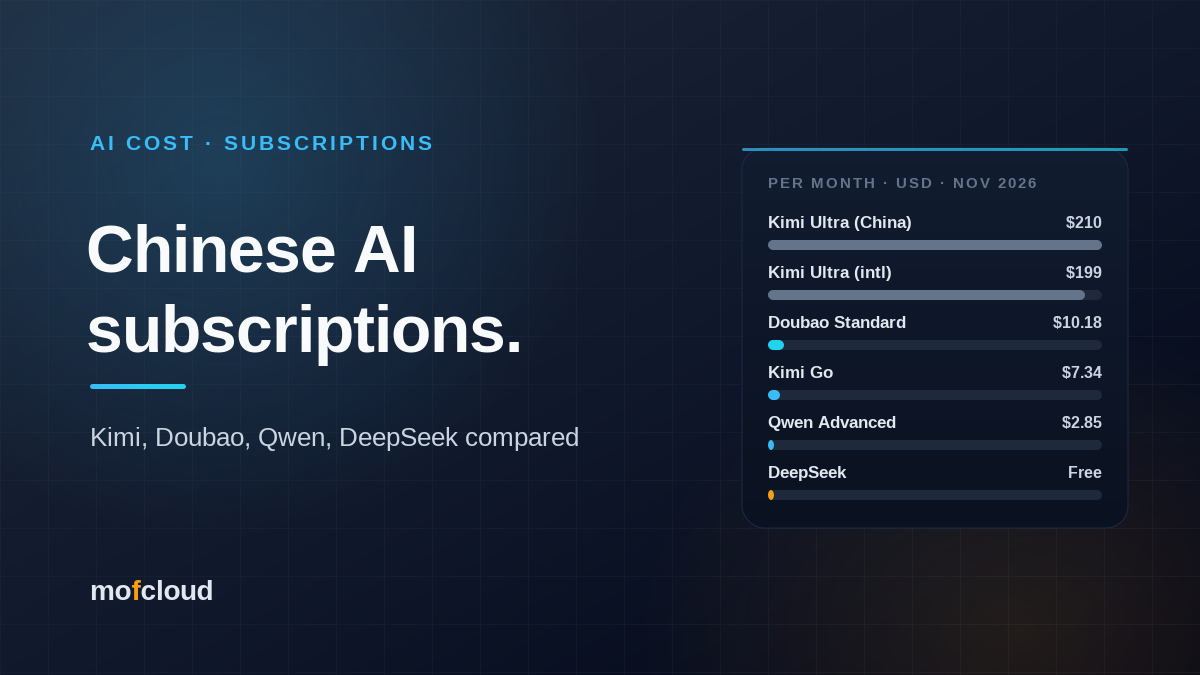
Kimi’s API is pay-as-you-go only; it’s billed separately from the Kimi consumer membership and Kimi Code.
- Minimum top-up: $1 to start using the API, and K3.1 Pro unlocks only after a successful top-up.
- Voucher: when your cumulative top-ups reach $5, you get a $5 voucher. Vouchers don’t count toward the cumulative total.
- Rate limits: concurrency, RPM, TPM and tokens per day scale with your cumulative top-up amount, so a new account starts on the lowest tier. Plan load tests accordingly.
Source: Kimi recharge and rate limits, as of November 22, 2026.
Kimi K2 is being retired: what migrating costs
Moonshot stopped offering K2-series models to new accounts on October 31, 2026, and plans to retire all of them by the end of December 2026. Existing users can keep calling them until then.
| Retiring model | Input | Output | Natural replacement | Change in list price |
|---|---|---|---|---|
kimi-k2.6 |
$0.95 | $4.00 | kimi-k3.1-pro ($2.00 / $10.00) |
about 2.1x input, 2.5x output |
kimi-k2.7-code |
$0.95 | $4.00 | kimi-k3.1-pro |
about 2.1x input, 2.5x output |
There’s no like-for-like cheap Kimi model in the K3 series, so a team on K2 faces a real price jump. That’s a good moment to benchmark K3.1 Pro against cheaper models like DeepSeek V4 Pro or GLM-5.3 on your actual prompts, rather than migrate by default. We track retirements like this one weekly in the Cloud & AI Briefing.
Tracking what Kimi actually costs you
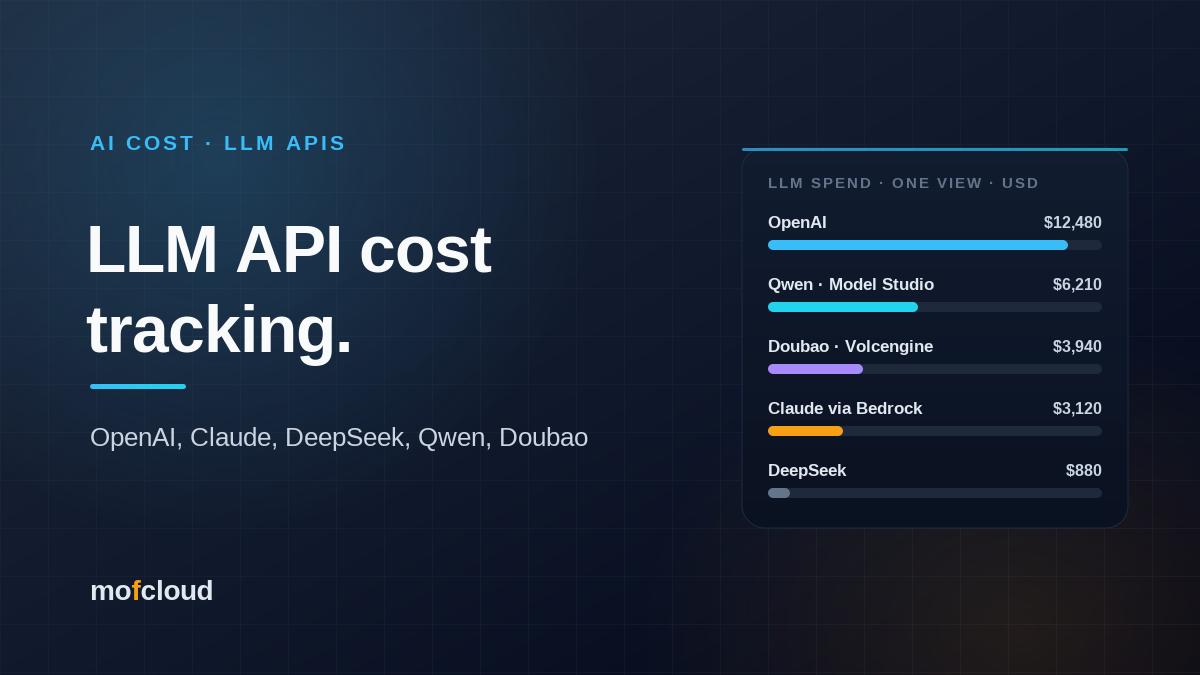
List prices tell you the rate; your bill depends on cache hit rate, reasoning effort and which model each key calls. If you use Kimi alongside OpenAI, Anthropic or Chinese clouds like Alibaba Cloud and Volcengine, Mofis puts those bills in one view and splits them by team, so a jump in output tokens after a model switch shows up the same week. Our post on LLM API cost tracking covers how to set that up.
FAQ
How much does Kimi K3 cost? $3.00 per million input tokens and $15.00 per million output tokens, with cached input at $0.30, as of November 22, 2026.
Is Kimi K3.1 Pro cheaper than Kimi K3? Yes. K3.1 Pro is $2.00 input and $10.00 output, a third less than K3 on every price line.
Does Kimi charge more for long prompts? No. Kimi K3 and K3.1 Pro have no prompt-length tiers; the per-token price is the same up to the 1M-token context window.
Does Kimi charge extra for thinking mode?
There’s no separate thinking price. Reasoning tokens are billed as output tokens, so higher reasoning_effort costs more through output volume.
Does Kimi have a batch discount?
Yes. The Batch API bills kimi-k3 and kimi-k3.1-pro at 60% of the standard price.
Is Kimi cheaper than Claude? Not at list price. K3.1 Pro matches Claude Sonnet 5.5 ($2 / $10) and K3.1 Pro Highspeed matches Claude Opus 5.5 ($4 / $20). DeepSeek V4 Pro and GLM-5.3 are the cheaper Chinese options.
What’s the minimum to start using the Kimi API? A $1 top-up. Reaching $5 in cumulative top-ups earns a $5 voucher.